In many organisations today, the CMO is expected to sit at the executive table, report directly to the CEO, and influence everything from revenue growth to customer experience. Yet despite this elevation, many businesses still lack clarity on what they actually want marketing leadership to deliver.
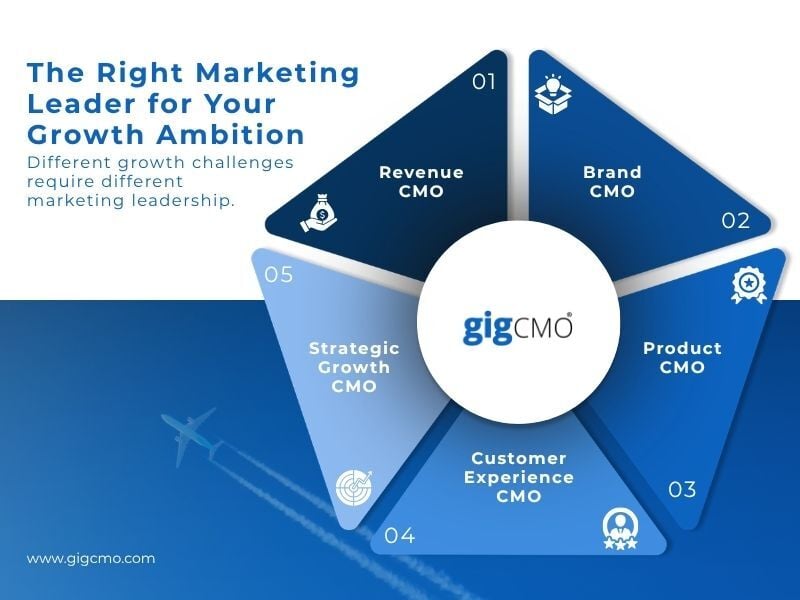
Below are the types of CMOs who will lead tomorrow's marketing, the business situations they are best suited for, and how a Fractional CMO Service allows businesses to access precisely the leadership you need.
1. The Revenue CMO
The Revenue CMO exists to answer one core business question: How does marketing directly contribute to revenue growth? This type of CMO is most valuable when a business needs a more predictable pipeline, better conversion rates, or tighter alignment between marketing and sales. Their focus is not on activity or visibility, but on commercial outcomes, pipeline quality, deal velocity, and revenue efficiency.
Revenue CMOs typically work very closely with sales leadership and revenue operations. They build demand engines, improve lead quality, and ensure marketing investment translates into measurable growth. For businesses under pressure to "prove ROI," this is often the most immediately impactful CMO profile.
Key points to remember:
- Best for businesses focused on pipeline growth and revenue efficiency
- Measures success through revenue, pipeline, CAC, and conversion metrics
- Works closely with Sales, RevOps, and leadership
- Ideal when growth exists but is inconsistent or inefficient
2. The Brand & Market Positioning CMO
The Brand CMO becomes critical when a business struggles to stand out. In crowded markets, buyers don't choose the best product; they choose the clearest and most credible story. This CMO type focuses on shaping how the company is perceived, trusted, and remembered.
Rather than chasing short-term leads, the Brand CMO builds long-term demand by clarifying positioning, strengthening messaging, and increasing brand authority. This work often shortens sales cycles, supports premium pricing, and creates pull from the market rather than push from sales.
Key points to remember:
- Best for crowded or commoditised markets
- Focuses on trust, differentiation, and long-term demand
- Measures success through brand awareness, engagement quality, and inbound demand
- Particularly valuable for B2B services and high-consideration purchases
3. The Product & Go-To-Market CMO
When businesses struggle with adoption, unclear messaging, or fragmented offerings, the problem is rarely "marketing execution"; it's product-market alignment. The Product CMO sits at the intersection of customer insight, product strategy, and go-to-market execution.
This CMO type ensures that what the business builds, how it is packaged, and how it is positioned actually aligns with customer needs. They play a critical role in launches, pricing input, segmentation, and ensuring that sales can articulate value clearly and consistently.
Key points to remember:
- Best for businesses with complex or evolving product portfolios
- Focuses on adoption, positioning, and go-to-market clarity
- Measures success through usage, adoption, churn, and expansion
- Works closely with Product, Sales, and Customer Success
4. The Customer Experience & Loyalty CMO
Acquisition alone is no longer a growth strategy. The Customer CMO focuses on retention, loyalty, and advocacy, turning existing customers into the strongest growth engine in the business. This role becomes essential when churn is high, expansion is weak, or customer experience is inconsistent.
Rather than viewing marketing as something that ends at conversion, this CMO designs end-to-end customer journeys. They build feedback loops, advocacy programmes, and community-driven growth that increase lifetime value and reduce reliance on constant new acquisition.
Key points to remember:
- Best for businesses with strong acquisition but weak retention
- Focuses on experience, loyalty, and customer-led growth
- Measures success through churn, retention, NPS, and expansion revenue
- Aligns Marketing, Customer Success, and Product around the customer
5. The Strategic Growth & Transformation CMO
This is the most senior and future-facing CMO type. The Strategic CMO helps businesses navigate change, new markets, new segments, new business models, or new operating realities. Their value lies not just in marketing outputs, but in strategic clarity and organisational alignment.
They define growth priorities, guide market entry decisions, modernise marketing capabilities (data, systems, AI), and ensure the business is set up to scale. This role is especially valuable during periods of transition, when leadership needs clarity rather than more activity.
Key points to remember:
- Best for scaling, international expansion, or transformation phases
- Focuses on strategy, market selection, and capability building
- Measures success through market penetration and execution effectiveness
- Acts as a strategic partner to the CEO and Board
Why Most Businesses Need the Right CMO?
Modern growth challenges are complex. Businesses expect marketing leaders to drive revenue, leverage data, integrate technology, attract talent, and collaborate across the organisation, often at the same time. Yet many CMOs find themselves absorbed by approvals, budgets, and operational firefighting.
This creates a paradox: organisations need marketing leaders to think long-term and steer growth, but internal structures often pull them into short-term execution.
The real issue is not whether a business needs a CMO, it is whether the organisation is designed to support the kind of leadership it expects. When marketing is expected to influence sales, finance, customer experience, and growth strategy, leadership must be enabled across the business, not confined to the marketing function.
Why the Fractional CMO Service Model Fits "Tomorrow's Marketing"
Traditional, full-time CMO roles are often too rigid for this reality, forcing organisations to commit to a single leadership profile even as priorities shift. The Fractional CMO Service model solves this by delivering senior marketing leadership that is flexible, targeted, and built around real business challenges.
Instead of expecting one executive to do everything, it provides the right type of CMO leadership at the right time, driven by a structured, proven growth playbook and a strong emphasis on capability building.
gigCMO's Fractional CMO Service model fits tomorrow's marketing because it:
- Provides C-suite-level direction that shapes growth strategy, aligns teams, and guides decision-making across the organisation.
- Uses proven frameworks and structured diagnosis to replace ad-hoc decisions with clarity, focus, and repeatable outcomes.
- Allows leadership focus to shift, from revenue growth to brand positioning to market expansion, without disruption or rehiring.
- Strengthens teams by embedding strategic thinking, better processes, and data-informed decision-making, rather than creating dependency.
- Brings together data, technology, AI, customer insight, and cross-functional alignment in a practical, business-first way.
Not Sure Which CMO You Need Right Now?
If you’re questioning whether to hire a CMO, what type of leadership will actually help you grow, or whether a full-time role is the right commitment, you’re not alone.
Talk to us about your growth challenge and discover whether a Fractional CMO is the right fit for your business right now.