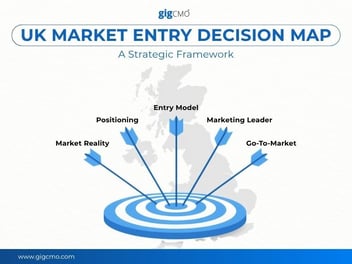
The UK is one of the largest and most sophisticated B2B economies. At the same time, the market is highly competitive.
In fact, the UK is currently the sixth-largest economy in the world, with a GDP of approximately £2.9 trillion. London alone hosts one of the highest concentrations of global B2B companies and financial institutions.
Yet despite the opportunity, many companies entering the UK market struggle to gain traction in their first 12–24 months. These challenges rarely occur because the UK market lacks opportunity.
More often, they arise from strategic assumptions made before entering the UK market. Below are five common mistakes companies make when expanding to the UK.
5 Strategic Mistakes When Expanding to the UK
1. Treating the UK as an Extension of Another Market
One of the most common assumptions when expanding to the UK is that existing positioning and messaging will translate directly.
However, buyer expectations and competitive narratives often differ significantly.
According to Demand Gen Report, more than 70% of B2B buyers conduct extensive independent research before engaging with vendors. In mature markets like the UK, this means buyers often arrive with a clear understanding of available alternatives.
Before launching, the company should:
- Analyse the UK competitive set
- Review how local competitors describe themselves
- Test whether its current value proposition is distinctive in UK buying conversations
- Adapt messaging for UK buyer priorities
This work ensures that the company's UK go-to-market strategy reflects market realities rather than assumptions from other regions.
2. Hiring a UK Marketing Agency Before Defining Market Strategy
Another recurring mistake is hiring a UK agency too early.
An agency can help execute campaigns, create content, manage paid media, and support lead generation. But an agency is not there to define the company's market entry choices.
If the business has not decided who it wants to target, what message it wants to lead with, and how it intends to win credibility, the agency will be asked to execute against ambiguity.
In a market where digital advertising spend has reached £35 billion, simply adding more campaigns does not create clarity.
Before appointing an agency, the company should define:
- The target segment in the UK
- The commercial objective of entry
- The UK value proposition
- The proof points needed to build trust
- The role marketing should play in the entry sequence
When these decisions are made first, agencies can execute campaigns that align with the company's UK market entry strategy.
3. Hiring a UK Marketer Without Strategic Direction
Local expertise can provide valuable insight into UK buyer behaviour.
However, it can also create unrealistic expectations if the organisation has not already defined its UK expansion strategy.
A single hire is often expected to simultaneously:
- Design the UK go-to-market strategy
- Build marketing infrastructure
- Generate an early pipeline
- Coordinate with global leadership
Without strategic alignment, this can lead to fragmented decision-making.
The challenge is balancing local knowledge with organisational clarity. Hiring locally can accelerate insight, but companies must ensure that the strategic direction for entering the UK market is already understood.
4. Launching Campaigns Before Validating Market Positioning
Another pattern observed in the UK market entry is launching campaigns before validating positioning.
Marketing campaigns often generate encouraging early signals such as website traffic, event registrations or inbound enquiries. However, these signals do not always translate into meaningful market traction.
This is particularly relevant in a competitive environment. In many sectors, UK companies invest significant resources in marketing and brand credibility.
Some industries allocate around 9–12% of revenue to marketing activities, highlighting the intensity of competition for buyer attention.
Companies expanding to the UK must therefore consider another strategic balance:
- Launch campaigns quickly to generate market feedback
- Validate positioning before scaling marketing investment
Rapid experimentation can reveal valuable insights, but it can also increase marketing spend without producing meaningful learning.
Validating positioning first may delay campaign activity, but it often improves the efficiency of future demand generation.
5. Confusing Activity with Market Traction
A final challenge when entering the UK market is interpreting early signals of success.
Initial activity may generate positive indicators such as website traffic, event participation or inbound enquiries. However, these signals do not necessarily represent genuine market traction.
True traction typically involves:
- consistent demand from a defined buyer segment
- repeatable pipeline generation
- clear differentiation from competitors
With so many companies entering the market, competition for attention and credibility is intense. Early activity does not automatically translate into sustainable growth.
Leaders must therefore assess whether early signals reflect meaningful progress or simply short-term visibility.
Taking a Structured Approach to Entering the UK Market
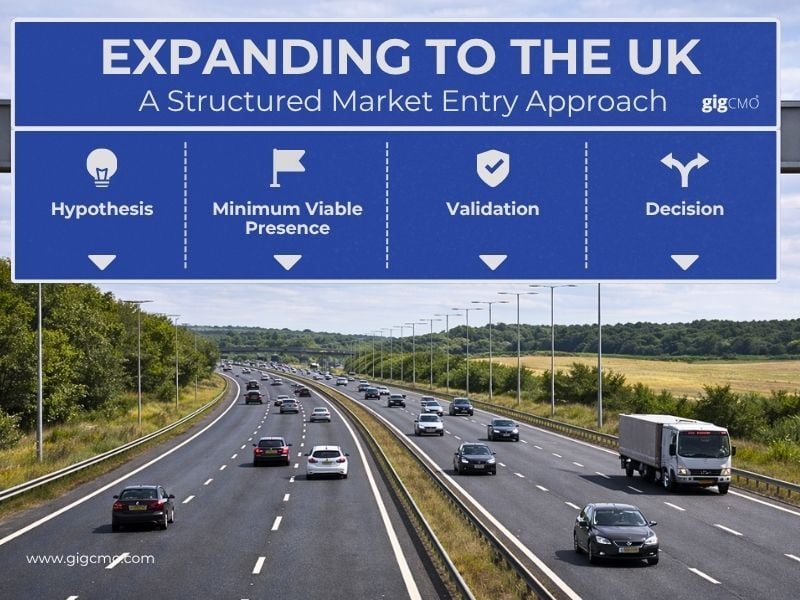
Many of the challenges described earlier occur because companies approach UK expansion as a launch activity rather than a structured process. A clearer approach is to treat market entry as a sequence of stages that progressively test assumptions before larger investments are made.
Below is a simple structure that organisations can use when entering the UK market.
Stage 1: Hypothesis
Every expansion strategy begins with a set of assumptions about how the market will respond. A market hypothesis makes those assumptions explicit.
For organisations entering the UK market, the hypothesis should address four key areas:
- Buyer demand – whether UK buyers experience the problem your offering solves
- Target segment – which specific industry or customer group you intend to serve first
- Competitive landscape – how established competitors currently position themselves
- Credibility requirements – what proof UK buyers expect before engaging with a new supplier
Clarifying these assumptions early allows leadership teams to test them systematically rather than relying on optimism or anecdotal signals.
Stage 2: Minimum Viable Presence
Once the hypothesis has been defined, the next step is establishing a minimum viable presence in the UK.
This stage is not about building a full operational structure. Instead, it focuses on creating enough credibility to engage with potential buyers and partners.
Typical elements of a minimum viable presence include:
- Founder-led or senior-led conversations with target customers
- Targeted outreach within a defined market segment
- Early pilot projects or proof-of-concept engagements
- Initial credibility signals, such as case studies or references
Many companies assume that credibility requires immediate investment in offices or teams. In practice, early credibility is more often built through direct engagement with potential customers.
Stage 3: Validation
After establishing a presence, organisations begin the process of validating market demand.
Validation focuses on determining whether early interest translates into genuine commercial potential. This involves analysing how prospects behave throughout the buying process rather than relying solely on expressions of curiosity.
Several signals help indicate whether demand is real:
- Prospects requesting follow-up meetings and involving additional stakeholders
- Discussions progressing towards implementation or commercial terms
- Sales cycles aligning with expected timelines
- Buyers accepting pricing and evaluating the solution against competitors
If signals remain weak or inconsistent, leadership may need to refine the target segment, reposition the offering, or adjust the commercial model before scaling.
Stage 4: Decision
The final stage of the framework is interpreting validation results and making a clear strategic decision.
At this point, leadership teams must determine whether the evidence justifies deeper investment in the UK market.
Three outcomes are possible:
Expand
Demand signals are strong, sales conversations progress consistently, and the commercial model appears viable. The company can begin building a more substantial UK presence.
Pivot
Interest exists but suggests a different opportunity than originally expected. This may involve focusing on a different market segment, adjusting positioning, or refining the offering.
Exit
Validation signals remain weak and indicate that the opportunity may not justify further investment.
Rather than assuming the UK market will respond in a particular way, organisations can test their assumptions, gather evidence and then make informed decisions about scaling their presence.
In our upcoming Land and Expand workshop, we explore the strategic decisions companies should clarify before hiring agencies, launching campaigns, or building local teams.
Contact us, if you are planning to enter the UK market or developing a UK market entry strategy. It will be useful to discuss your starting point, examine the sequence of decisions that must be made before significant investment occurs.