B2B lead generation in 2026 isn't about getting "more leads", it's about generating the right leads that convert into revenue. If your business is investing in marketing but still not winning consistent customers, it's usually because your strategy is missing the structure that turns attention into pipeline.
At gigCMO, we help UK businesses grow with our Fractional CMO Service, providing marketing leadership driven by a growth playbook and transferring the knowledge your team needs to execute confidently. This guide is designed to help you understand what's changed, what's going wrong, and what to do differently in an AI-driven market.
What B2B Lead Generation Means in 2026
B2Blead generation is the system your business uses to attract potential customersand turn them into qualified sales conversations. It’s harder in 2026 becausebuyers are more informed, more selective, and less responsive to genericoutreach.
Most UK B2B buyers now research heavily before they ever speak to a supplier, meaning your brand must influence decisions earlier than ever. If your business isn’t visible during that research phase, you’re often excluded before the buying conversation even starts.
The Real Reason YourMarketing Isn’t Producing Customers
Many businesses think the problem is the channel, but the real issue is usually the lack of a connected process. You can run ads, publish content, and post on LinkedIn, but without a clear path to conversion, results stay inconsistent.
The most common situation is this: marketing generates activity, but sales doesn’t get the right leads at the right time. When that happens, marketing feels like a cost, and sales feels like it’s doing all the heavy lifting.
What usually goes wrong:
- You attract the wrong audience (too broad or poorly targeted)
- You generate leads but don’t qualify them properly
- Your follow-up is slow or inconsistent
- Your messaging sounds like everyone else in the market
- Marketing and sales aren’t aligned on what “good” looks like
The Numbers Decision Makers Should Know for 2026
Lead generation performance gaps are widening because top performers are building systems, while others are still running isolated campaigns. That’s why some companies grow predictably while others feel stuck despite spending more.
Here are a few benchmarks that explain what’s happening in the market right now. These numbers matter because they highlight why strategy beats tactics in 2026.
Key lead generation benchmarks:
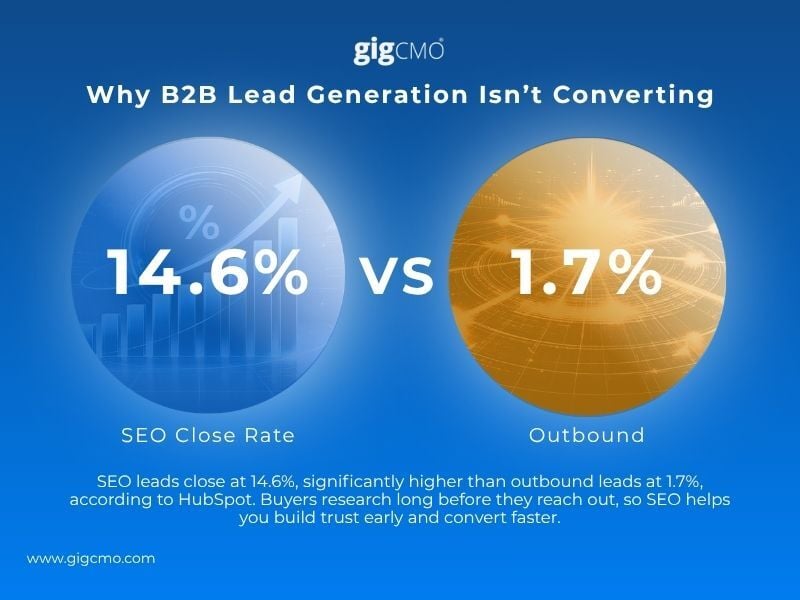
- SEO leads close at 14.6% vs outbound at 1.7% (HubSpot)
- Average MQL-to-SQL conversion is around 13% (industry average)
- Scoring can improve MQL-to-SQL conversion to ~39–40% (benchmarks)
- The average B2B buying cycle is ~11.3 months
- 24% are exploring updating their SEO strategy for generative AI in search (e.g. ChatGPT, Gemini, Claude)
The Buyer Journey Has Changed, and Your Lead Strategy Must Match It
Today’s B2B buyers don’t want to be sold too early, they want to be educated early. If your content doesn’t build trust during the research phase, your sales team will face price objections and stalled deals later.
Buyers now complete most of their decision-making before contacting a vendor, and many already have a preferred option when they reach out. This means your lead generation must focus on earning trust before the first meeting, not just collecting form fills.
Lead Generation vs Demand Generation (You Need Both)
Lead generation captures demand that already exists, like someone searching for your service and filling in a form. Demand generation creates interest before people are ready to buy, so you become the obvious choice when they are.
Businesses that only focus on lead generation usually get inconsistent results because they depend on timing. Businesses that invest in demand generation build pipeline stability because they influence the market before competitors do.
Asimple way to think about it:
- Lead generation = capture existing intent
- Demand generation = create intent and preference
The 2026 Lead Generation Playbook That Actually Works
A working lead generation strategy is a connected system, not a list of tactics. It should guide a buyer from awareness to decision with clear messaging, strong proof, and friction-free conversion points.
The strongest strategies in 2026 combine data, content, automation, and sales alignment. They don’t rely on “one channel”; they rely on consistency and conversion discipline.
What a strong lead gen system includes:
- Clear ICP and buyer roles (not vague personas)
- Strong positioning and differentiation
- Content mapped to buyer questions
- Conversion paths that match buying readiness
- Lead scoring and qualification rules
- Fast follow-up and nurturing sequences
- Reporting tied to pipeline, not vanity metrics
The Best B2B LeadGeneration Channels in 2026 (UK Focused)
The best channels are the ones that match how your buyers research and make decisions. In the UK, this usually means a combination of organic visibility, trusted networks, and targeted distribution.
Channel performance varies widely depending on your industry and deal size, so strategy matters more than trends. The goal is not to “be everywhere” but to dominate the channels that drive qualified intent.
Channels that consistently perform well:
- SEO and thought leadership content
- LinkedIn (organic + targeted paid)
- Email nurturing and re-engagement
- Webinars and expert sessions
- Partnerships and referral ecosystems
How AI Is Changing B2BLead Generation in 2026
AI is transforming lead generation by improving speed, personalisation, and decision-making. It helps businesses prioritise the right leads faster and automate repetitive work that slows teams down.
The advantage isn’t “using AI tools”, it’s using AI inside a structured growth playbook. Without a strategy, AI simply helps you scale the wrong message to the wrong audience more efficiently.
Where AI adds real lead gen value:
- Behaviour-based lead scoring and prioritisation
- Faster content production with better consistency
- Smarter segmentation and personalisation
- Automated follow-up and routing
- Better insight into what’s working and why
What UK BusinessesShould Do If Lead Gen Isn’t Working
If your marketing spend isn’t producing customers, don’t start by changing platforms. Start by fixing the strategy, funnel, and execution system behind your marketing.
Once the system is working, you can scale channels confidently. That’s how you avoid the common trap of spending more money to get the same disappointing results.
Fix these first:
- Clarify who you want to win and why you’re the best choice
- Improve your website conversion paths and lead capture logic
- Align sales and marketing on what qualifies as a good lead
- Implement behavioural scoring and better follow-up speed
- Build content that supports long buying cycles and trust-building
How gigCMO Helps YouBuild Predictable Lead Generation
gigCMO’s Fractional CMO Service gives your business senior marketing leadership. We drive growth using a proven playbook and transfer knowledge to your team so you build long-term capability.
We also work with leading tools like HubSpot Marketing Hub to power pipelines, automate engagement, and measure impact end-to-end. HubSpot users report a 505 % ROI over three years, with a 107 % increase in leads within the first six months of implementing Marketing Hub.
If you want predictable growth, you need leadership, a proven playbook, and the capability to execute in an AI-driven market. That’s exactly what gigCMO’s Fractional CMO Service is designed to deliver, let's talk.