Every founder begins as their company's first marketer. You write the pitch deck, demo the product, and convince early customers with passion and conviction.
This approach works brilliantly in the early stages, but it has a natural expiration date. What once fuelled growth eventually becomes the bottleneck that stalls it.
This blog explores why founder-led marketing thrives initially, why it inevitably breaks down, and how to evolve into scalable marketing to grow your business.
Why Founder-Led Marketing Works So Well Early On
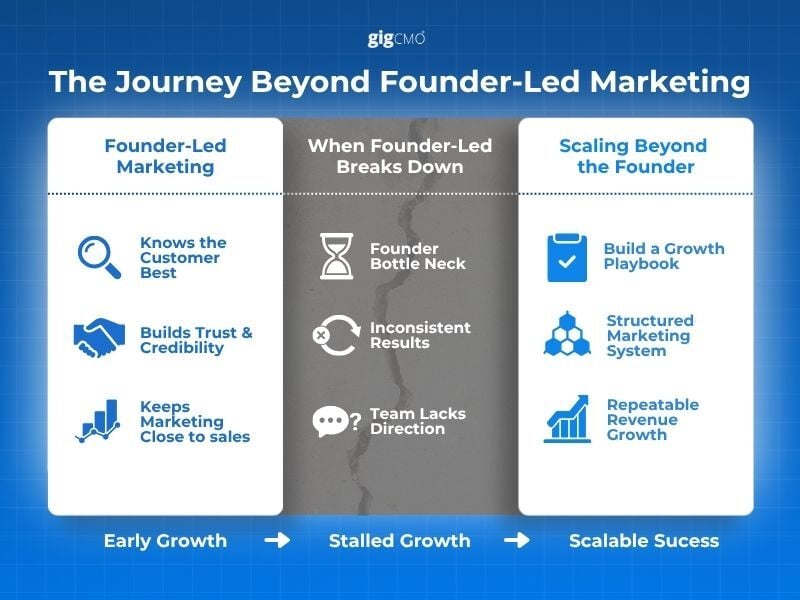
Founder-led marketing works because it is close to the source.
The founder has direct access to customer insight, product context and commercial urgency. That combination is difficult to replicate in the early stages of growth.
The Founder Understands the Customer Best
In the early stage, the founder usually knows the customer better than anyone else in the business.
They have heard the same objections repeatedly. They know which problems create urgency. They know which features matter, which messages land and which promises feel credible.
This makes founder-led marketing sharper than generic marketing activity. It is grounded in real conversations rather than assumptions, the same type of insight that later needs to be formalised through strategic marketing leadership.
The Founder Creates Early Trust and Credibility
Buyers often trust founder-led communication because it feels more direct and more accountable.
A founder can explain not only what the business does, but why it matters. They can bring a point of view to the market. They can articulate the problem in a way that feels commercially relevant, not just promotional.
This is particularly important in B2B markets where trust, expertise and credibility influence buying decisions.
The Founder Keeps Marketing Close to Sales
Founder-led marketing also helps prevent one of the most common growth problems: marketing becoming detached from sales.
When the founder is involved, marketing is usually closer to the real buyer journey. Content is more likely to reflect actual customer questions. Messaging is more likely to support sales conversations. Campaign ideas are more likely to connect to revenue, not just visibility.
This is why founder-led marketing can be such an effective growth lever.
Until the business needs consistency, repeatability and scale.
When Founder-Led Marketing Starts to Break
Founder-led marketing usually starts to break when the business moves from proving demand to scaling growth.
At this stage, the company no longer needs occasional marketing activity. It needs a marketing system.
The founder's judgment still matters, but it cannot be the only mechanism holding everything together.
The Founder Becomes the Bottleneck
The first warning sign is usually time.
The founder is still approving content, rewriting messaging, reviewing campaigns, directing priorities and joining too many conversations because nobody else can explain the value clearly enough.
Marketing slows down because decisions wait for the founder. The team may be capable, but they do not have the strategic clarity needed to move confidently without constant input.
Marketing Activity Stops Compounding
Another sign is that marketing activity increases, but results do not compound.
The business may be posting regularly, running campaigns, experimenting with AI tools, using freelancers, sending emails and creating assets. But the pipeline remains inconsistent. It is unclear what is working. Results do not justify the effort or the spending.
This is often not an effort problem. It is a prioritisation problem. The business is active, but the activity is not governed by a clear system for decision-making, sequencing or measurement.
The Team Waits for Direction
As the business grows, the team needs more than ideas. It needs clear direction.
Without that, everything feels important. Priorities change too often. Marketing becomes reactive. The team produces more, but not necessarily better outcomes.
This is a common pain point for founder-operators: they are already doing marketing, often with tools, freelancers or AI support, but the outcomes are inconsistent and unclear.
What Needs to Change as You Scale
The goal is not simply to do more marketing as you scale. The goal is to build a repeatable growth playbook that turns founder insight into structured decisions, consistent execution and measurable commercial progress.
A growth playbook gives the business a shared way to decide what to focus on, how to execute, how to measure progress and how to improve over time.
It moves marketing away from founder dependency and towards a system the wider team can understand and run.
Capture What the Founder Knows
The first step is to extract the knowledge that currently sits with the founder.
This includes the ideal customer profile, buyer pain points, common objections, sales narratives, proof points, market context, competitor positioning and the reasons customers choose the business.
Much of this knowledge already exists, but it is often informal. It appears in sales calls, founder conversations, investor updates, proposals, LinkedIn posts and product discussions.
The playbook turns that knowledge into a structured asset that the business can use.
Define the Commercial Priorities
A growth playbook should make clear what the business is trying to achieve and what marketing needs to support.
That means identifying the priority audience, the main growth objective, the most important revenue opportunities and the biggest barriers to conversion. Without this clarity, marketing becomes a collection of disconnected activities.
With it, the team can make better decisions about where to focus, what to build and what to stop doing.
Turn Strategy into Repeatable Execution
The playbook should then translate strategy into practical execution.
This includes the core messaging, content themes, campaign priorities, channel choices, sales enablement assets, outbound support, follow-up journeys and measurement framework.
The point is not to create a static document that sits in a folder. The point is to create an operating system for growth.
Everyone should understand what the business is trying to say, who it is trying to reach, which activities matter most and how success will be judged.
Create a Clear Decision Cadence
A growth playbook also needs rhythm. The business should know when marketing performance is reviewed, what data is discussed, which decisions are made and how priorities are adjusted.
This prevents the founder from being pulled into every tactical choice.
Instead of relying on instinct, the business has a structured cadence for learning, decision-making and improvement.
That is how marketing starts to compound.
Ready to Scale Beyond Founder-Led Marketing?
If your business is growing, but marketing still depends too heavily on founder input, it may be time to step back and redesign the system.
Our online workshop is designed for businesses that want to scale and grow with clearer marketing priorities, stronger commercial focus and a more structured approach to execution.
We help you identify what is working, what is creating noise, where founder dependency is holding growth back and what marketing system needs to be built next.
Join our online workshop and start growing your business.

%20-%20Blog%20-%20Op3.png?width=352&name=Why%20Your%20Marketing%20Activity%20Is%20Not%20Turning%20into%20Pipeline%20(And%20How%20Founders%20Can%20Fix%20It)%20-%20Blog%20-%20Op3.png)