
We were recently asked, 'Have you ever been anxious about business strategy and survival?' In a world of bravado, statistics, data and jargon, it's a very human question and one that just about every business owner contends with daily.
One hopes that as time goes by, and depending on your personality, the feeling of anxiety gives way to simply being aware rather than worried about your company's success. However, in many ways, anxiety about company survival and the relevance and efficacy of your business strategy is a sign of someone motivated, awake, and eager to succeed.
Only the paranoid survive
'Only the paranoid survive', wrote Andrew Grove, the CEO of Intel Corporation. He should know- he wrote the book on the topic. It is a powerful comment that many will identify with and draw comfort from- knowing others have felt the same way.
The quote speaks to a normal set of feelings and acknowledges that companies will invariably have difficult periods. Nonetheless, with the right leadership, and a little luck, hard times can be some of the most critical moments in an individual or company's career.
Optimising for market fit
Worry tends to come from an acute awareness that things can happen, things change, and that you have to continue to stay relevant if you want to succeed in your relevant market. All companies should constantly be optimising for market fit, reviewing and refining their proposition to ensure that they continue to deliver a product or service that fills a demand.
Even the most established brands can face enormous challenges. If the pandemic has taught us anything, it is that nothing is certain. For lots of businesses, the status quo has changed forever. Consider airlines.
If anyone had told you three years ago that they might need bailing out, you would have thought it was impossible. However, airlines are likely to have to reconsider their offering indefinitely in a post-lockdown world.
None of us can predict the future, and we can only deal with the situations that we have in front of us. However, awareness that things can and will change, along with a business strategy designed to absorb impact and adapt, is invariably the key to survival.
The power of leadership
Paranoia for business leaders is generally an indicator of care. There is a lot for CEOs and business owners to think about. In a regular job, you worry about your role and your ambitions.
To a greater or lesser extent, you can trust that someone else is responsible for the company's success, and to some degree, that person also has your career progression in mind.
When you are a business owner or in a leadership position, the responsibility for the business's success lies with you, but so too does the security of other people's livelihoods, whether it's because they are your clients or part of your team.
Strong leadership isn't about being suffocated by that responsibility but being aware of it and taking it seriously. In many ways, sitting back and getting too comfortable would be a deeply problematic place to be.
Surrounding yourself with good people
While data and digitisation are central to a modern way of working, having the right people on your side is still the most significant asset a company can have. You need to have people in your corner who you trust, who are aligned with your vision for your company, and who are passionate about the company's values.
You can tell a lot about a business by the commitment of its people. It is no secret that there is currently a skills shortage. Companies are quickly recognising that attracting and keeping talented individuals committed to and engaged with their jobs is no mean feat.
Who you have on your team should be as big a part of your business strategy as defining your pricing strategy or understanding customer behaviour.
Turning business strategy anxiety into better decisions
Some degree of concern about the future is a normal part of leadership.
But that concern becomes far more manageable when leaders can see that the business has a structured way of identifying problems, prioritising opportunities and turning decisions into action.
That requires several things working together:
- A clear understanding of the markets and customers the business wants to pursue
- A proposition that gives those customers a compelling reason to choose the business
- A disciplined way of deciding which growth opportunities should be prioritised
- Marketing activity connected to pipeline, revenue and wider commercial objectives
- Clear ownership across the people responsible for delivery
- Regular review of performance so decisions can be adjusted using evidence
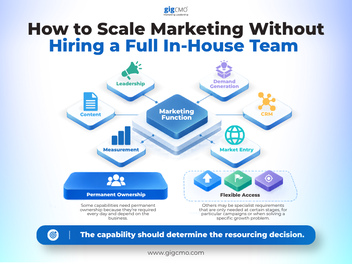
- The capability to execute consistently without every decision returning to the founder or CEO
This is where gigCMO works with growing businesses.
We provide senior marketing leadership and the specialist execution capability needed to turn commercial priorities into action.
Our Business Growth Playbook provides the structure. Senior leadership helps determine what needs to happen and in what order. Our in-house marketing team provides the specialist capability required to execute against those priorities.
The objective is not to create more marketing activity.
It is to help the business make better marketing decisions, execute them properly and build the internal capability and confidence to grow.
For founders and leadership teams, that provides something particularly valuable in an uncertain market: greater clarity over what the business should do next.
You cannot remove uncertainty, but you can improve how you respond to it
No leadership team can predict every change in its market.
What businesses can control is the quality of the system they use to respond.
A strong strategy gives direction. Clear priorities turn that direction into decisions. Effective leadership creates accountability. Good execution turns those decisions into commercial outcomes.
That will not remove every concern a founder or CEO has about the future.
But it does mean uncertainty is less likely to result in reactive activity, wasted investment or constant changes in direction.
Instead, it becomes something the business is equipped to manage.
Speak to gigCMO about strengthening your marketing leadership, priorities and execution.
Watch the Video
Listen to the Audio