
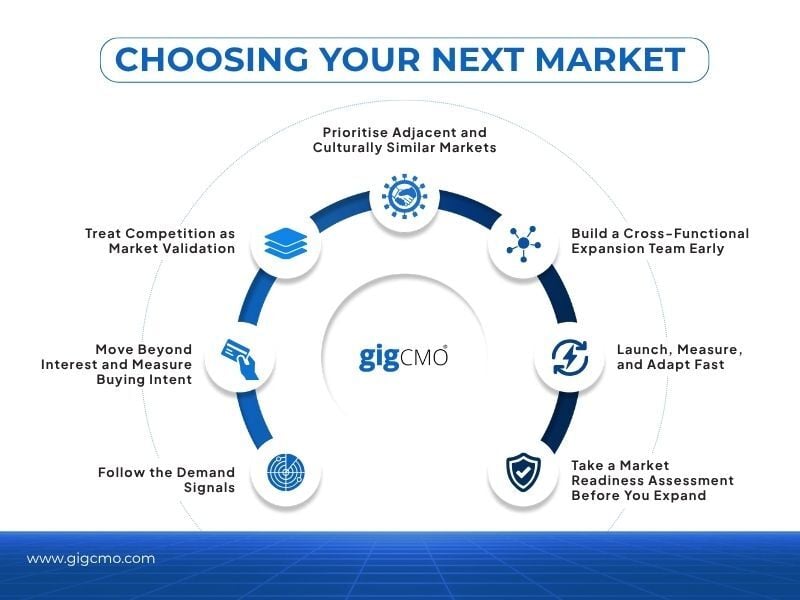
International expansion is becoming a necessity for growth-minded businesses. But with dozens of possible markets to choose from, how do you know which one is right?
Rather than relying on intuition or reputation alone, the best expansion strategies are grounded in hard evidence and objective evaluation of where demand truly exists and where your organisation can realistically win.
This blog walks you through a data-driven approach to choosing your next market, one that helps you make strategic decisions aligned with your capabilities and designed to help you expand into markets where you can succeed.
1. Follow the Demand Signals You Already Have
These are not random metrics; they are real expressions of interest from potential buyers. If a country consistently shows above-average engagement or direct inquiries, that's a strong indicator of latent demand. Prioritising markets with existing interest increases your chances of faster adoption and return on investment.
Here are the strongest demand signals to review:
- Which countries generate organic website traffic?
- Where do you see the highest inbound leads?
- Are there clusters of engagement from regions you haven't formally entered?
- Are certain products or features more popular in specific geographies?
2. Move Beyond Interest and Measure Buying Intent
High traffic doesn't always mean high intent. Sometimes people are curious, but not ready to buy, or your offer doesn't align with local expectations. That's why conversion behaviour matters more than vanity metrics.
The goal here is to determine whether prospects in a specific geography behave like real buyers. Instead of focusing only on awareness, look for proof that users take meaningful steps toward purchase or adoption.
Here are some data points to evaluate:
- Conversion or trial-to-paid rates by region
- Customer retention and usage patterns in similar markets
- Local customer feedback about features or pricing
- Language and regulatory support requirements
3. Treat Competition as Market Validation
It's natural to worry when you see competitors already active in a market. But in many cases, competition is a sign that the market is mature enough to buy solutions like yours.
A market with no competitors might sound appealing, but it can also mean the market isn't ready, budgets don't exist, or buyers don't understand the category yet. Competition often signals that buyers are educated, and that spending is already happening.
Evaluate these competitive insights:
- Who the top competitors are and how you position yourselves
- Which segments you serve best (and which you ignore)
- Where customer reviews show frustration or unmet needs
- Whether pricing is premium, mid-market, or race-to-the-bottom
- How saturated the market feels in paid search and outbound channels
4. Prioritise Adjacent and Culturally Similar Markets
Some of the smartest expansions are not the most dramatic ones. Instead of jumping into the biggest market globally, many companies succeed by moving into nearby or similar markets first, then using that experience as a blue print for more complex expansion later.
Adjacent markets tend to be easier to test because they often share business norms, buying behaviours, or language overlap. However, similar does not mean identical, so your strategy must still account for local nuance.
When assessing adjacent opportunities, explore factors like:
- Shared language or bilingual market penetration
- Similar customer expectations and purchasing cycles
- Regulatory alignment or trade partnerships
- Ease of logistics and support coverage
5. Build a Cross-Functional Expansion Team Early
Market expansion shouldn't be driven by one person alone. It impacts your product, pricing, delivery, and customer experience, so you need a small cross-functional group to pressure-test decisions and stay aligned.
A cross-functional team ensures your expansion is strategically smart(you choose the right market and the right approach) and operationally realistic.
Your team should be supported by:
- Marketing leadership to set direction and make the right calls
- A clear growth playbook your small team can follow
- Alignment between sales, product, and delivery
- Consistent execution across channels
- Shared metrics and performance tracking
- A scalable process you can reuse in the next market
6. Launch, Measure, and Adapt Fast
Even the best market choice doesn't guarantee instant success. The first90–180 days in a new market should be treated as a learning phase. Your goal is to validate assumptions quickly and improve performance through iteration.
The most effective post-entry approach is to monitor early traction and adjust your execution plan based on what the data says. That means tracking:
- Customer acquisition cost (CAC) by channel
- Conversion rate from lead to opportunity
- Activation rate and time-to-value
- Retention and customer feedback
- Revenue growth compared to the forecast in 90–180 days
7. Take a Market Readiness Assessment Before You Expand
Expanding into a new market isn't just about choosing the right country; it's about making sure your business is actually ready to win there. Many businesses move too quickly because the opportunity looks exciting, only to struggle once execution begins.
A Market Readiness Assessment helps you evaluate the areas that most directly impact success. It gives you clarity on what's strong, what's missing, and what needs to be built before you invest time, money, and team energy.
There are four key areas that influence your probability of success in entering a new market:
- Target market identification and understanding
- Business model and value proposition relevance
- Marketing strategies and tactics
- Resources available for deployment in the new market
Take the Market Readiness Assessment here.
Expand Where You Can Win
Choosing your next market isn't about picking the biggest country or the most impressive city. It's about finding the place where demand is real, fit is strong, and your business can win.
If you're planning to enter a new market but don't have the internal structure, capabilities, or marketing leadership to execute confidently, gigCMO can help.
gigCMO's Fractional CMO Service provide the marketing leadership you need to expand in to a new market with confidence, using a playbook-driven approach that helps you build the right capabilities, align your team, and focus on the GTM activities that drive real traction, so you're not just entering a market, but setting up to win it.
Our distinctive strength comes from firsthand experience gained through living and working across diverse global markets. That perspective gives us a deep understanding of both the excitement and the uncertainty that come with scaling beyond your home market, and the practical steps needed to turn expansion into sustainable growth.



.jpg?width=352&name=20260521%20-%20Blog%20What%20Worked%20in%20One%20Market%20Wont%20Work%20in%20Another%20-%20gigCMO%20-%20Op3%20(1).jpg)