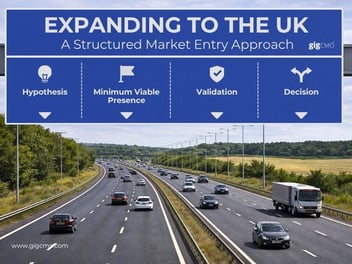
Entering the UK market is often perceived as straightforward, particularly for companies already operating internationally.
However, experience across many expansion initiatives shows that the challenge rarely lies in launching activity.
Instead, difficulties arise when key decisions about positioning, market focus and resource ownership are made too late or in the wrong order.
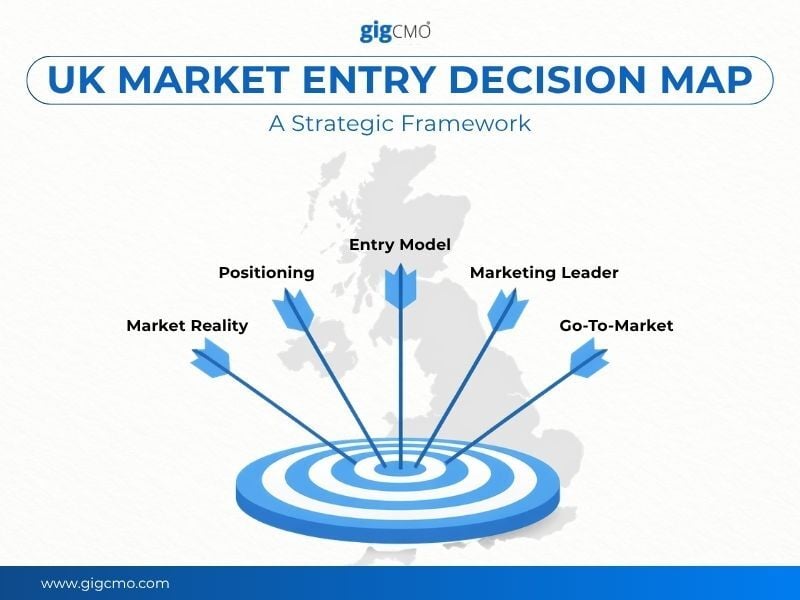
This article introduces the UK market entry decision map, a practical framework designed to help leadership teams structure their UK market entry strategy before making a significant investment.
What the UK Market Entry Decision Map Is Designed to Solve
The UK market entry decision map addresses this problem by structuring the strategic decisions that should be made before execution begins.
Instead of starting with marketing activities, the framework focuses on clarifying the assumptions that shape the entire expansion effort.
These decisions influence how a company positions itself, how demand is generated and which resources are required to sustain growth.
Decision 1: Market Reality Assessment
The first step in any UK market entry strategy is understanding the market itself. The UK is a mature economy with a strong commercial infrastructure and highly competitive industries.
According to our research, the UK remains a premier global destination for foreign direct investment, ranking third worldwide. Driven by strengths in AI, clean energy, and financial services, the country boasts a robust, business-friendly environment.
However, the same strengths that attract companies also create a competitive environment where differentiation is essential.
A market reality assessment helps organisations understand the environment they are entering by examining:
- Competitive landscape and dominant players
- Category maturity and demand levels
- Buyer expectations and procurement processes
- Geographic industry clusters across the UK
Decision 2: Defining the UK Positioning Statement
Positioning is often where companies encounter the first major obstacle when entering the UK market. Messaging that resonates strongly in one country does not always translate effectively to another.
The UK market is particularly sensitive to differentiation because buyers often evaluate multiple competing providers before making purchasing decisions.
A practical way to refine positioning when expanding to the UK is to follow a structured value proposition process that aligns customer needs with the product offering.
- Define the target audience: Identify the specific UK customer segments being served and understand their needs, motivations and concerns.
- Clarify the product offering: Clearly explain the challenge the product or service solves, including the benefits customers gain, the features that enable those benefits and the overall experience customers will have when using the solution.
- Align product and customer priorities: The strongest value propositions directly connect product benefits with customer needs, ensuring that the offer addresses real pain points and opportunities within the UK market.
- Establish differentiation: Companies must articulate why their offer is better than existing alternatives, whether through technology, pricing, service quality or cultural relevance.
Decision 3: Selecting the Right Entry Model
Once market reality and positioning are clear, the next decision is how the company will actually enter the UK market. The entry model determines how demand will be generated, how customers will be acquired and how much investment will be required in the early stages of expansion.
Businesses expanding to the UK typically consider three broad entry approaches:
- Market testing through marketing and partnerships to validate demand before building a local team
- Partner-led expansion, where local distributors or strategic partners help access customers
- Direct commercial expansion, involving hiring UK sales or marketing teams early in the process
Choosing the right model depends on several factors, including the maturity of the category in the UK, the company's available resources and the level of risk leadership is prepared to accept when entering the market.
In many cases, organisations combine these approaches by validating demand first and gradually increasing investment as market traction becomes clearer.
Decision 4: Hire a Marketing Leader
A marketing leader plays a central role in helping organisations expanding to the UK navigate the complexities of a new market.
They bring strategic oversight to ensure that messaging resonates with UK buyers, that marketing initiatives are aligned with commercial goals and that internal teams and external partners operate within a coordinated framework.
By interpreting market signals and adjusting strategy as new insights emerge, marketing leadership enables companies to refine their UK go-to-market strategy while maintaining momentum during the expansion.
In practice, marketing leaders support UK expansion by guiding several critical areas:
- Aligning marketing, sales and leadership teams around a clear market strategy
- Shaping positioning and messaging to resonate with UK buyer expectations
- Coordinating agencies and partners so that marketing activity supports the same strategic direction
- Continuously refining demand generation and growth priorities based on market feedback
Decision 5: Go-To-Market Execution
When expanding into the UK, go-to-market execution should focus on validating demand while strengthening the company's market presence.
Rather than launching large-scale campaigns immediately, organisations benefit from starting with targeted initiatives that test messaging, refine audience targeting and identify where the strongest traction is emerging.
This approach allows marketing and commercial teams to learn from real market responses and adjust the strategy before scaling investment.
Effective go-to-market execution typically involves several coordinated activities:
- Launching targeted demand generation initiatives aimed at clearly defined UK buyer segments
- Building credibility through thought leadership, content and market presence
- Supporting sales efforts with messaging and campaigns aligned to UK buyer expectations
- Refining marketing activity based on market feedback and early commercial outcomes
By approaching go-to-market execution as a structured process, companies entering the UK market can move from early market validation to sustainable growth while ensuring that marketing investment remains aligned with strategic priorities.
Structuring Your UK Market Entry Strategy
The market entry decision map provides leadership teams with a structured way to evaluate the decisions that shape a successful expansion.
By clarifying these factors before committing significant resources, organisations can reduce risk, prioritise the right opportunities and build a more disciplined path into the UK market.
If your organisation is considering entering the UK market, or has already begun exploring expansion but is facing uncertainty around positioning, entry model or go-to-market execution, taking a structured approach to these decisions can significantly improve the likelihood of success.
At gigCMO, we support B2B companies expanding into the UK through our Fractional CMO Service. We provide strategic marketing leadership to guide market entry, align teams around a clear go-to-market plan and structure execution using our business growth playbook.
Alongside delivering strategic direction, we work closely with internal teams to transfer knowledge and build the marketing capability required to sustain long-term growth.
If you want to explore how a structured approach could support your UK market entry strategy, you can contact gigCMO to start the conversation.