
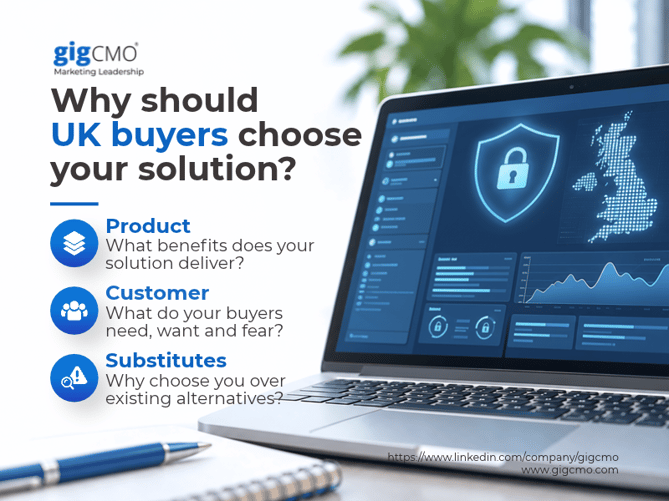
Your cybersecurity solution may have advanced technical capabilities, proven performance and established customers in your home market. But can you explain why a UK business should invest in it?
Cybersecurity buyers need to understand how your solution addresses their business risks, what benefits it delivers and why they should choose it over existing alternatives.
Here are five areas to consider when developing a value proposition that supports customer acquisition in the UK.
1. Understand What UK Cybersecurity Buyers Value
Before explaining your technology, understand the business problems your prospective customers need to solve.
The UK's National Cyber Security Centre (NCSC) recommends communicating cybersecurity risks in terms of their impact on business operations, customers and organisational objectives.
Identify Customer Needs, Wants and Concerns
Your customer research should explore three areas:
- Rational needs: Technical performance, system integration, compliance requirements and operational efficiency.
- Desired outcomes: Greater confidence in security arrangements, improved protection and reduced pressure on internal teams.
- Underlying concerns: Implementation costs, operational disruption, supplier reliability and uncertainty about results.
Understanding these factors helps you identify which benefits matter to your target customers.
Understand Different Buying Priorities
Cybersecurity purchasing decisions may involve several stakeholders.
A Chief Information Security Officer (CISO) may prioritise reducing security exposure. A finance director may focus on costs and expected returns. An IT manager may be concerned about integration and implementation.
Your value proposition needs to communicate a consistent benefit while addressing these different priorities.
2. Translate Technical Capabilities into Business Outcomes
Technical features explain how your solution works. Buyers also need to understand what improvements those features could deliver.
Connect Features, Benefits and Customer Experience
The Product component of gigCMO's Value Proposition Framework examines three elements.
Consider a cybersecurity platform that automates threat investigation:
These elements explain the solution's functionality, potential value and practical implications for the customer.
Make Your Value Proposition Customer-Focused
Instead of leading with a description such as:
"An AI-powered cybersecurity platform with automated threat investigation capabilities."
Consider explaining the operational benefit:
"Reduce the time your security team spends investigating routine alerts, so analysts can focus on threats that require their attention."
The second message addresses a customer problem and communicates a potential outcome. However, the expected benefit must be supported by evidence from relevant testing or customer deployments.
3. Show Why Customers Should Choose Your Solution
UK cybersecurity buyers may already use established providers, security platforms or internal solutions.
Your value proposition needs to demonstrate why considering another supplier would be worthwhile.
Evaluate Competitors and Existing Alternatives
According to Vanson Bourne's How Brands Know research, seven in ten surveyed buyers reported increasing difficulty identifying meaningful differences between cybersecurity vendors. The research covered 300 IT and security decision-makers across the UK and US.
This reinforces the importance of clear competitive positioning.
Research the solutions your prospective customers currently use. Identify where your technology offers improvements and whether those improvements address a priority the customer is willing to invest in.
Understand the Barriers to Switching Providers
The Substitutes component of gigCMO's framework also considers customer resistance to change.
For example, your solution may offer better threat detection performance. However, a customer may already have substantial investment in an existing security platform.
Switching could involve additional costs, technical integration and staff training. Your value proposition should explain whether the additional benefit justifies those commitments.
4. Demonstrate the Financial and Operational Value
Customers may recognise the benefits of your cybersecurity solution but still need a credible business case to justify the investment.
Quantify the Potential Business Benefits
Consider a hypothetical example. A security team receives 2,000 alerts each month. Of these, 30% require manual investigation, taking an average of 15 minutes per alert.
That represents 150 hours of investigation work per month. If your solution demonstrates a 40% reduction in investigation time, the potential benefit would be 60 hours saved each month.
The customer can then evaluate the value of that time against licensing, implementation and ongoing operating costs.
Time savings do not necessarily translate into direct financial savings. They may instead increase the team's capacity to manage higher-priority security activities.
Support Your Claims with Evidence
Your value proposition becomes more credible when prospective customers can assess the evidence behind your claims.
Useful supporting materials include customer case studies, measurable performance results, independent technical evaluations and relevant product demonstrations.
Where possible, use the customer's own operating data to assess potential improvements.
The objective is to help buyers make an informed decision about the expected benefits and costs.
5. Support the Cybersecurity Buying Decision
Your value proposition also needs to work throughout the customer's purchasing process.
Provide Information for Different Decision-Makers
Different stakeholders may require different evidence.
Technical teams may need integration documentation and performance results. Finance teams may require implementation costs and expected financial benefits. Executive leadership may want to understand the implications for business continuity and operational risk.
Your marketing materials should help each stakeholder evaluate the solution and explain its value internally.
Align Marketing and Sales Communications
Your website, customer case studies, product demonstrations and sales presentations should communicate the same core value proposition.
For international cybersecurity companies without established UK references, evidence from customers in other markets can support credibility.
However, you need to demonstrate how those results relate to UK customer requirements.
Consistent communication across marketing, sales and technical teams helps prospective customers assess your solution throughout the buying process.
Is Your Cybersecurity Value Proposition Convincing UK Buyers?
Before investing further in UK customer acquisition, consider whether your value proposition clearly explains:
At gigCMO, our Business Growth Playbook includes a structured Value Proposition Framework that helps businesses understand customer needs, evaluate competitive alternatives and strengthen their market positioning.
We can help you review your existing value proposition, identify gaps in how you communicate your commercial value and develop an approach to refining your positioning for the UK market.
Contact gigCMO to discuss the right approach to refining your value proposition.