In a world full of AI-generated content, generic posts and overly polished brand messaging, everyone eventually comes up for air and asks the same question.
Where are the humans?
That is partly why founder-led marketing has become such a big topic.
Over the past year, more founders, CEOs and senior leaders have started putting themselves at the front of their brands. They are posting on LinkedIn, sharing Reels, and even doing TikToks. They are becoming the face, voice and personality behind the business.
And in many ways, that makes sense.
People connect with people more easily than they connect with a company logo, product page or corporate campaign. A founder can bring energy, conviction and context that a brand account often cannot.
At its best, founder-led marketing creates trust.
But what happens when it goes wrong?
When Founder-Led Marketing Feels Anything But Human
McDonald’s recently gave us a useful example.
A few months ago, its CEO appeared in a video eating one of the company’s burgers.
On paper, the idea probably made sense. The leader of the business was showing up, engaging with the product and putting a human face behind the brand. It was meant to feel direct, and relatable.
People noticed the small details. How uncomfortable the CEO seemed. The way he described the burger. The fact that he referred to it as a “product”, rather than what most people would call it: a burger.
Instead of feeling natural, it felt forced.
Instead of creating connection, it created distance.
 His reaction says otherwise
And that is the point.
The lesson is not that CEOs should never appear in marketing.
The lesson is that putting a senior person in front of the camera does not automatically make something authentic.
Human visibility is not the same as human connection.
And founder-led marketing is not automatically good marketing just because the founder is involved.
Why Founder-Led Marketing Became So Popular
Founder-led marketing has become popular because the market has changed.
Audiences are surrounded by more content than ever. AI has made it easier to produce posts, blogs, emails, scripts, campaigns and opinions at speed. Businesses can now create more output with less effort.
But more output has not created more trust. In many cases, it has created more noise.
In B2B especially, this matters.
Buyers are not just buying a product or service. They are buying judgement, credibility, confidence and fit. They want to know whether the people behind the business understand their world.
The Problem Starts When Founder-Led Becomes Founder-Dependent
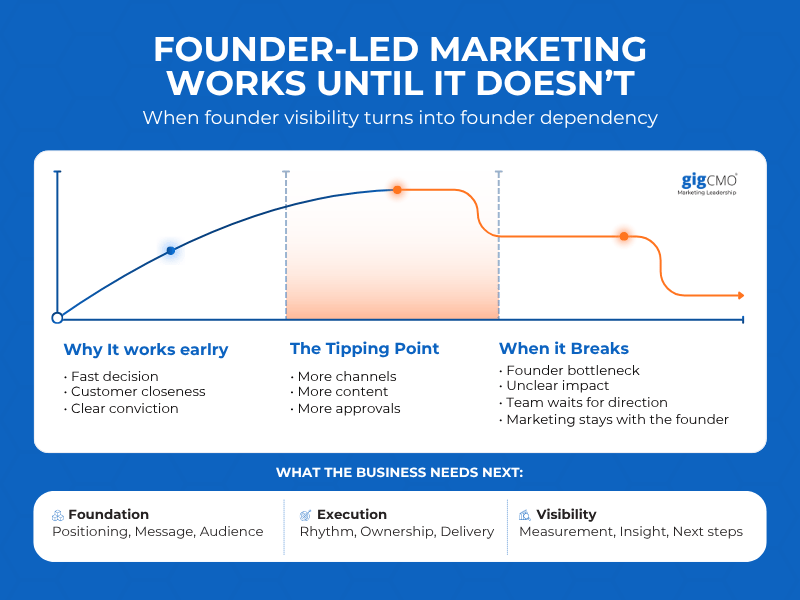
In the early stages of a business, founder-led marketing often works because the founder is closest to everything that matters.
They usually know the customer better than anyone else. They understand the objections. They know why prospects hesitate. They can explain the product, the problem and the market in plain language because they have lived it.
That gives founder-led marketing real strength.
But founder-led marketing works until it becomes founder-dependent marketing.
The problem is not that the founder is visible. The problem is when marketing cannot move without them.
This is where many growing B2B businesses get stuck.
There may already be marketing activity in place. There may be a marketer, an agency, freelancers, LinkedIn content, email campaigns, CRM, AI tools, reports and regular sales outreach.
But behind the scenes, the founder is still carrying too much of the thinking.
The founder is still shaping the message, approving the content, correcting the positioning and deciding what matters. They are still being pulled into campaign decisions, content reviews and questions about what should happen next.
At that point, marketing has not really come off the founder’s plate.
It has just become more active around them.
This is where founder-led marketing starts to break.
Visibility Is Not a Marketing System
One of the risks with founder-led marketing is that businesses start to confuse visibility with strategy.
But visibility on its own does not mean marketing is working.
A proper marketing system needs more than a visible founder.
It needs prioritisation.
It needs execution rhythm.
It needs measurement.
It needs a way to turn insight into action without everything going back to one person.
Without those foundations, founder-led marketing can become another form of noise.
If the founder is still the only person who understands the customer, AI will not fix that gap. It will simply create more things for the founder to review, correct or reject.
More content does not solve a marketing leadership problem.
How to Know Founder-Led Marketing Has Reached Its Limit
Founder-led marketing may have reached its limit when the same patterns keep appearing.
- The team cannot move without direction.
- The founder keeps rewriting the message.
- Marketing activity is happening, but the commercial impact is unclear.
- Reports show what happened, but not what to do next.
The question is not whether the founder should be visible. In many businesses, they should be.
The better question is this:
Can marketing work without everything coming back to the founder?
Is Marketing Still on Your Plate?
If marketing activity is increasing but decisions, approvals and direction still come back to you, the issue may not be capacity.
It may be that the business has not yet built the structure needed to turn your knowledge into a repeatable marketing system.
At gigCMO, we help founder-led businesses build that structure. We bring marketing leadership and execution together, so priorities are clearer, decisions move faster and the team can operate with greater confidence without everything depending on the founder.
The aim is not to remove the founder from marketing.
It is to make sure marketing can continue to work when the founder steps away.
Talk to gigCMO about building a marketing function that can move forward without every decision coming back to you.

%20-%20Blog%20-%20Op3.png?width=352&name=Why%20Your%20Marketing%20Activity%20Is%20Not%20Turning%20into%20Pipeline%20(And%20How%20Founders%20Can%20Fix%20It)%20-%20Blog%20-%20Op3.png)