
To successfully scale a B2B business, leaders must combine data-driven market intelligence with a structured scoring framework. For founders and leadership teams, the challenge is not simply identifying where growth could come from. It is deciding which opportunities deserve capital, management attention and execution capacity now, and which should wait.
That decision matters because the cost of choosing the wrong opportunity extends beyond the money invested. It also includes the time, capability and focus that could have been concentrated on a stronger opportunity where the business had a better chance of winning.
How to Identify Growth Opportunities
Look across four primary areas to identify untapped revenue potential:
- Core Expansion: Audit current accounts for upsell and cross-sell potential using white-space analysis.
- Market Penetration: Find lookalike companies within your existing best-performing verticals.
- Market Development: Explore adjacent industries or new geographic regions that share your core ICP characteristics.
- Product Optimisation: Review customer churn data and product usage gaps to uncover unmet needs and opportunities for new features or services.
Once you have assessed these four areas, you will typically end up with a longlist of potential opportunities. The next challenge is turning that longlist into a ranked set of priorities. Here is a step-by-step way to do that.
How to Prioritise Growth Opportunities
Step 1: Build a Structured View of Opportunities
Before you can prioritise anything, you need a complete and comparable list of candidate opportunities. The ideas from your initial assessment will typically fall into a few categories:
A common mistake is comparing opportunities that have been identified in fundamentally different ways, perhaps one from a sales anecdote, another from a market report and another from a founder's instinct.
Before assessing them, restate every opportunity in the same format: the target segment, the problem it solves, the size of the opportunity and the resources required to pursue it. This alone can remove much of the ambiguity from the discussion.
Step 2: Size the Market Properly
For each opportunity, you need a defensible view of market size and growth, using the standard layers:
In B2B, SAM is often where expectations become inflated. A market may be enormous in aggregate, but if your proposition only fits companies of a certain size, industry or level of maturity, the genuinely addressable opportunity may be a fraction of the headline number.
Interrogate this early. Overestimating the serviceable market can create an unrealistic business case before the investment decision has even been made.
Growth rate matters alongside size. A smaller, fast-growing niche may represent a better opportunity than a large but stagnant market, particularly if you have the potential to establish a strong position before larger competitors respond.
Step 3: Assess Attractiveness Beyond Size
Market size and growth are important, but they are not enough to determine whether an opportunity deserves investment.
A rigorous assessment should also consider:
Step 4: Assess Your Right to Win
An attractive market only matters if your business has a credible chance of capturing it.
This is where many B2B growth plans become overly optimistic. They identify an attractive market without sufficiently considering whether the organisation is positioned to compete effectively within it.
Key factors include:
A useful check is to identify the three hardest things about winning the opportunity. If you cannot provide credible answers for each of them, the opportunity's true feasibility is probably lower than the optimistic case suggests.
Step 5: Score and Plot Opportunities
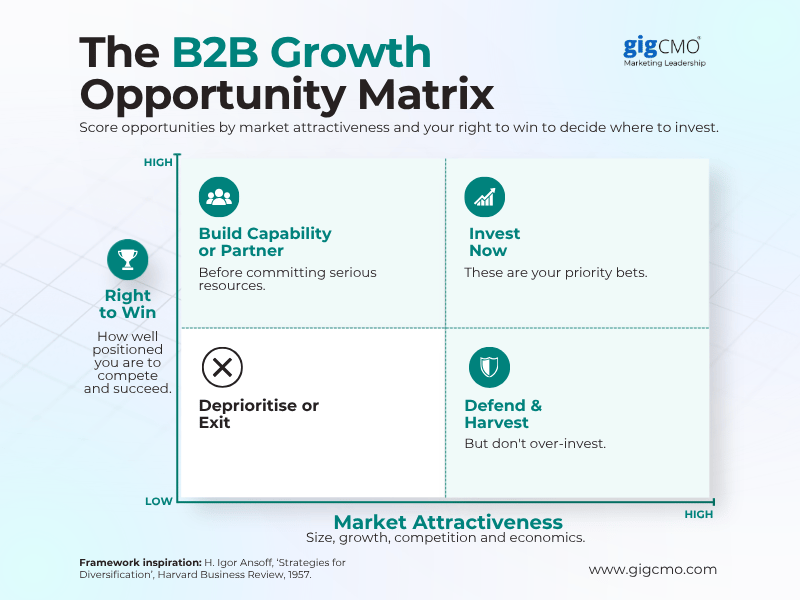
Once you have assessed market attractiveness and your right to win, you can compare opportunities using a two-axis prioritisation matrix.
Each opportunity can then be assessed against a consistent set of criteria.
|
Criterion |
Weight |
Example Scoring Basis |
|
Market size (SAM) |
20% |
Revenue potential in target segment |
|
Growth rate |
15% |
CAGR of the segment |
|
Competitive intensity |
15% |
Number and strength of incumbents |
|
Product/GTM fit |
20% |
Effort required to serve segment well |
|
Economics (LTV:CAC) |
15% |
Modelled unit economics |
|
Strategic value |
15% |
Optionality it creates for future growth |
This produces four broad categories:
Example: Comparing Three Growth Opportunities
Imagine a B2B software business is considering three possible routes to growth:
Leadership scores each opportunity from 1 to 5 against the agreed criteria, then applies the weighting.
|
Criterion |
Weight |
Opportunity A |
Opportunity B |
Opportunity C |
|
Market size (SAM) |
20% |
3 |
5 |
4 |
|
Growth rate |
15% |
3 |
5 |
4 |
|
Competitive intensity |
15% |
4 |
3 |
2 |
|
Product/GTM fit |
20% |
5 |
3 |
2 |
|
Economics |
15% |
5 |
4 |
3 |
|
Strategic value |
15% |
4 |
4 |
5 |
|
Weighted score |
100% |
4.0 |
4.0 |
3.3 |
On the headline score alone, Opportunities A and B look equally attractive. But the two-axis matrix reveals an important difference.
Opportunity A has moderate market attractiveness but a strong right to win. The business already understands the buyer, has relevant proof, an established sales motion and attractive economics. It may therefore represent the strongest near-term growth opportunity.
Opportunity B has greater market attractiveness, but the business has a weaker right to win. Entering the sector may still make strategic sense, but leadership may choose to validate demand, build relevant proof or develop partnerships before committing significant resources.
Opportunity C offers strategic potential, but the combination of weaker go-to-market fit, higher competitive pressure and greater investment required makes it a less compelling immediate priority.
The decision might therefore be:
This is why the matrix should support leadership judgement. Two opportunities can achieve similar overall scores while requiring very different investment decisions.
Step 6: Stress-Test with Scenarios, Not Just Averages
A single-point score can hide a lot of risk. Before finalising priorities, run each shortlisted opportunity through a few scenario questions:
This is particularly important in B2B, where a single large logo win can create false confidence that a segment is easier to penetrate than it actually is.
How gigCMO Helps Businesses Identify and Prioritise Growth
Identifying an attractive growth opportunity is only the first step. The harder part is deciding whether the business is genuinely positioned to win, what needs to be validated before further investment, and how to turn that decision into a practical route to growth.
gigCMO works with founders and leadership teams to bring structure to that process. Using our Business Growth Playbook, we help businesses:
The objective is not to pursue every possible route to growth. It is to give leadership greater confidence about where to focus, what to invest in now, what to validate first and what should wait.
Contact gigCMO and start identifying growth opportunities to build a position you can realistically win today.

.png?width=352&name=20260817%20-%20How%20to%20Identify%20Which%20Gap%20Is%20Blocking%20Your%20B2B%20Pipeline%20-%20Op4%20(2).png)

%20-%20Blog%20-%20Op3.png?width=352&name=Why%20Your%20Marketing%20Activity%20Is%20Not%20Turning%20into%20Pipeline%20(And%20How%20Founders%20Can%20Fix%20It)%20-%20Blog%20-%20Op3.png)