
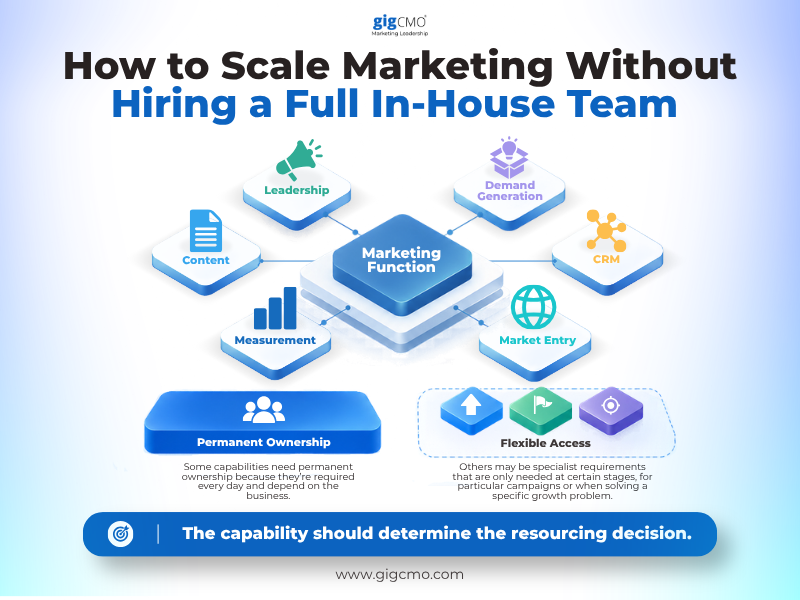
A growing business can scale its marketing without immediately building a large internal department. The starting point is to work out which marketing capabilities the growth plan requires, which need permanent ownership, and which can be accessed when required.
This gives the business a way to increase marketing capability while keeping its structure proportionate to the work it actually needs to deliver.
Why Marketing Becomes Harder to Scale as a Business Grows
Marketing tends to become more complicated as the company adds customers, markets, channels, technology and suppliers. Research from McKinsey illustrates the wider problem.
In its survey of 104 marketing and growth executives, only 27% said their organisations had mature marketing operating models with the capabilities, talent and partnerships needed for more advanced marketing.
McKinsey also found that adding new responsibilities to existing structures can create silos, duplicate work, and additional layers of decision-making.
Five Signs Your Marketing Is Struggling with Scale
1. Marketing decisions still depend on the founder or CEO
In the early stages, founder involvement is often a strength. The founder knows the customers, the offer and the commercial priorities better than anyone else. But as the business grows, every campaign, supplier decision and marketing approval cannot continue to depend on one person.
If marketing cannot move forward without regular founder direction, the business may increase activity without building the systems, ownership, and decision-making capacity needed to scale. The issue is not founder involvement itself; it is whether the business has created enough marketing independence to grow without becoming a bottleneck.
2. The marketing team is covering too many capabilities
Growing businesses need several marketing disciplines at once: customer insight, positioning, content, demand generation, CRM, website optimisation, reporting and sales enablement. It is unrealistic to expect one generalist marketer to be a specialist in every area.
A joint research paper by Simply Business and the Federation of Small Businesses has found that 19% of young entrepreneurs reported struggling with marketing knowledge and understanding. As activity expands, the question is not always whether to hire more people immediately. It may be whether the business needs flexible access to expertise that the existing team does not have.
3. Marketing activity is becoming fragmented
In one SME Marketing Report, 46% of respondent said they did not have a formal marketing strategy, while another 6% were unsure whether they had one. At the same time, businesses were using a mix of internal resources and external marketing support to deliver activity.
This becomes harder to manage as more channels, suppliers and tools are added. An SME can have a website supplier, a freelancer, an internal marketer, and separate sales activity, all producing work, while nobody has a clear responsibility for bringing it together around the same commercial priorities.
4. Leadership cannot clearly connect marketing to the pipeline and revenue
According to Forrester, 64% of B2B marketing leaders do not trust their organisation's marketing measurement framework to make commercial decisions, primarily due to fragmented tech systems and misaligned definitions.
This matters because additional marketing investment needs to be based on evidence. Leadership needs to understand which activity is producing useful enquiries, a qualified pipeline, and revenue, rather than relying mainly on traffic, engagement, or the volume of marketing produced.
5. The marketing model has not evolved with the business
As we explain in From Startup to Scale-Up: How Your Marketing Model Needs to Evolve, scaling means increasing revenue without allowing cost, complexity and management dependency to increase at the same rate. An informal marketing model that worked when the business was smaller can struggle as more customers, channels, people and revenue targets create more decisions.
If marketing still relies on the same structure despite the business becoming more complex, adding campaigns or people can create more coordination rather than better performance. The marketing model needs to evolve through clearer leadership, defined decision ownership and enough capability for the team to keep moving as the business grows.
What Marketing Capabilities Does a Growing Business Actually Need?
Start with the commercial objective rather than the job title.
If the business wants more qualified pipeline, it needs the ability to identify the right buyers, generate demand, support conversion and understand which activity contributes to revenue.
If the company plans to enter a new market, it may need market validation, positioning, demand generation and go-to-market leadership.
If marketing still depends heavily on the founder, the immediate requirement may be stronger leadership and clearer decision ownership.
A simple capability review can connect business priorities to the marketing requirements behind them:
|
Commercial priority |
Marketing capability to assess |
|
Generate more qualified pipeline |
Demand generation and conversion |
|
Improve return on marketing investment |
Measurement, attribution and prioritisation |
|
Reduce founder dependency |
Marketing leadership and ownership |
|
Enter a new market |
Market validation and go-to-market capability |
|
Improve execution |
Specialist expertise and delivery capacity |
|
Improve sales and marketing coordination |
Commercial planning, CRM and handover processes |
This distinction matters because a business might believe it needs another Marketing Manager when the real gap sits in senior leadership, CRM, demand generation or commercial measurement.
The capability should determine the resourcing decision.
How Should a Growing Business Resource Its Marketing Capabilities?
Once the business knows which capabilities it needs, the next question is how to access them. Some capabilities need permanent ownership because they are required every day and depend heavily on knowledge of the business. Others may be specialist requirements that are only needed at certain stages, for particular campaigns or when the company is solving a specific growth problem.
A growing business can therefore combine its existing internal team with senior marketing leadership and specialist expertise rather than hiring a full-time employee for every capability. The right structure depends on how frequently each capability is required, how important internal ownership is and whether there is enough ongoing work to justify another permanent role.
How Marketing Leadership as a Service Supports Growing Marketing Needs
Scaling marketing does not always require a larger in-house department. For many start-ups, scale-ups and SMEs, the more immediate need is stronger leadership, clearer priorities and access to the right capabilities as the business grows.
Marketing Leadership as a Service gives leadership teams senior marketing direction without requiring them to build a full senior marketing structure from the outset. At gigCMO, we use our Business Growth Playbook to connect commercial priorities to marketing decisions, clarify where growth is being constrained and define what the marketing function needs to deliver next.
From there, gigCMO helps coordinate the right mix of internal capability, external specialists, agencies and technology. This means a business can strengthen areas such as content, demand generation, CRM, website development, paid media or market-entry activity when needed, without assuming every capability must become a permanent role.
The value comes from creating accountability around marketing as a commercial function. That includes setting priorities, aligning marketing with sales, improving visibility over pipeline contribution and reviewing performance against the outcomes the business is trying to achieve. It also reduces the risk of adding people, suppliers or tools before the underlying requirement is clear.
As the business develops, the model can evolve with it. Some capabilities may eventually warrant permanent in-house ownership once there is enough consistent demand and workload to justify it. Others can remain flexible where the requirement is more specialist or variable.
If you are reviewing how your marketing function should scale, contact gigCMO to discuss where the current gaps sit and what mix of leadership, internal capability and specialist support makes sense for your next stage of growth.