leade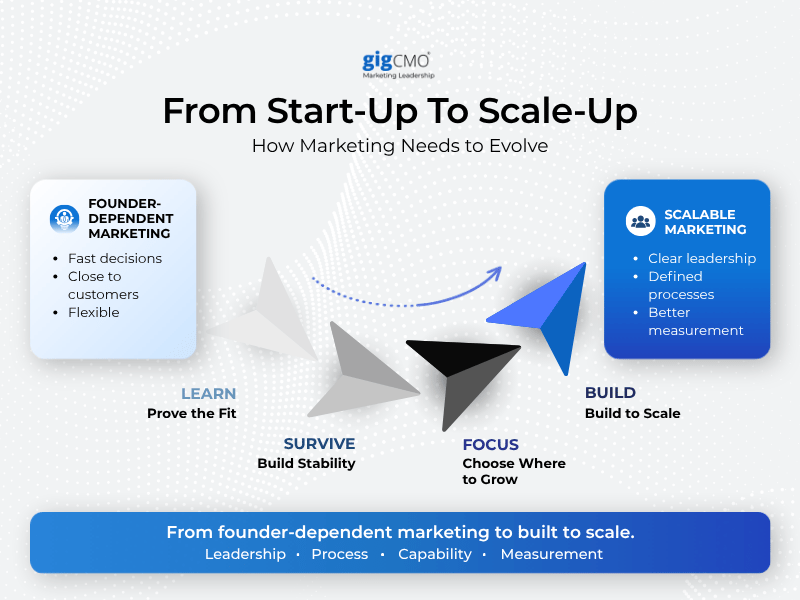
Before a business can scale, it has to work out where sustainable growth will come from. It needs evidence that customers want what it sells, enough revenue to survive, a clearer idea of where to focus, and the capability to deliver consistently.
Marketing plays a different role in each of these stages. During the early years, much of it can sit with the founder. Decisions are fast, customer knowledge is close, and the business can change direction quickly.
That model becomes harder to manage when the company starts to scale. More customers, people, channels, and revenue targets create more decisions. Marketing has to develop from something driven largely through founder knowledge and individual effort into a function the business can rely on.
What Stages Does a Start-up Go Through Before Scaling?
There is no fixed route that every start-up follows, but four stages are useful when thinking about readiness to scale: learning, survival, focus and building.
1.Learning: Proving Product-Market Fit
The business is trying to establish product-market fit.
Early customers provide evidence that the problem is worth solving, but the company is still learning which customers have the strongest need, why they buy, what proposition gets a response, and how demand can be created.
The founder is usually close to this work. Conversations with customers feed directly into decisions about the product, pricing, positioning, and sales approach.
Marketing at this point should generate useful market feedback as well as demand. Spending heavily to increase volume before the business understands what works can simply make the learning process more expensive.
2.Survival: Building Commercial Stability
Early demand has been established, but the business still needs commercial stability.
Revenue and cash flow take priority. There may be good months followed by weak ones. A few large customers may account for a substantial proportion of income.
Marketing becomes more disciplined because resources are limited. The company needs to understand which activity can contribute to sales, and which activity is consuming time or budget without enough return.
Survival creates an important test: can the business turn initial customer wins into a more dependable flow of opportunities?
3.Focus: Choosing Growth Opportunities
As the company learns more about its market, the number of possible growth opportunities often increases.
There may be several customer segments that could be pursued. New channels become available. The team sees potential partnerships, geographic markets or propositions.
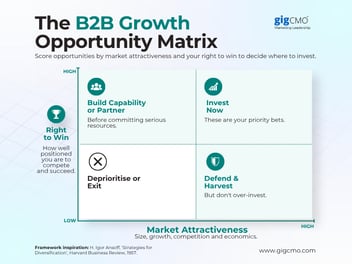
A business preparing to scale needs to decide where it has the strongest chance of winning. That means making choices about target customers, positioning, routes to market and where marketing resources should go.
Without those choices, growth activity becomes fragmented. Teams stay busy, while management keeps changing priorities because several opportunities appear equally attractive.
4.Building: Choosing Marketing Model for Scale
Once the direction is clearer, the business needs enough capability to support it.
This is often when marketing starts to expand beyond the founder. A marketing executive may be hired. Agencies or freelancers may be added. CRM, automation and reporting tools begin to appear.
The company is building the foundations it will need for the next stage.
At this point, leadership should be able to explain where growth is expected to come from, which customers the business wants to win and how marketing supports the commercial plan.
Then the marketing challenge changes again.
What Changes When a Business Starts to Scale?
Scaling means increasing revenue without increasing cost, complexity and management dependency at the same rate.
For marketing, this creates a practical problem. The informal model that supported a smaller business cannot carry an increasing volume of decisions indefinitely.
founder-dependent marketing works well when the founder can stay close to customers and personally direct priorities. As the organisation grows, that dependence starts to slow the team down. The founder becomes an approval point for messaging, campaigns, expenditure and day-to-day decisions.
The marketing model now needs to evolve
Marketing leadership needs to become clearer
Hiring people gives the business additional capacity. It does not automatically give the marketing function direction.
Someone still needs to decide which markets deserve attention, where budget goes, which campaigns come first and how marketing should respond when performance changes.
As the company scales, these decisions need clear ownership. The founder remains involved in business direction, while marketing leadership converts that direction into priorities the team can execute.
This reduces the number of routine decisions that need to return to the founder.
Marketing needs an operating model
A growing team needs more than a collection of job descriptions and campaign briefs.
A marketing operating model defines how the function works. It covers how decisions are made, how work is prioritised, how execution is managed and how performance is reviewed.
For example, a team may have strong content, paid media and CRM specialists but still struggle because nobody has agreed which customer segment is the priority for the quarter. Each person can execute well while the combined activity produces little commercial movement.
An operating model gives that work a common direction.
For a scaling business, this usually means setting a planning cadence, assigning decision ownership, defining how sales and marketing work together and creating a consistent way to review performance.
Measurement needs to support commercial decisions
Marketing reporting also has to mature.
Traffic, reach, engagement and lead volume can tell the team whether activity is happening and whether people are responding. Leadership needs another layer of information when deciding where to invest.
Which activity is creating qualified opportunities? Which customer segments are progressing through the pipeline? Where are prospects dropping out? Which marketing investments should receive more budget?
Good measurement makes those decisions easier.
It also changes the conversation between marketing and leadership. Reporting becomes a way to decide what happens next rather than a record of what the team completed last month.
The marketing model should reduce dependency as the company grows
A scalable marketing function can continue operating when the founder is unavailable for a week.
The team knows who the priority customers are. Positioning is documented. Responsibilities are understood. People can make decisions within agreed boundaries. Performance is reviewed against commercial objectives.
This does not require a large marketing department. An SME or scale-up may use a combination of internal people and external specialists. The structure matters more than the headcount.
The aim is to create enough leadership, process and capability for marketing to keep moving as the business grows.
Is Your Marketing Model Ready For Scale?
If your business has moved beyond the start-up stage, but marketing still depends heavily on the founder, shifting priorities or disconnected activity, the issue may be the marketing model itself.
Scaling requires clearer leadership, stronger decision-making, a defined operating model and better connection between marketing activity and commercial outcomes.
At gigCMO, we help founders and leadership teams build the marketing structure needed for the next stage of growth. We combine senior marketing leadership, our Business Growth Playbook and an in-house execution team to turn priorities into measurable action.
If your business is scaling and your current marketing model is starting to hold you back, contact gigCMO to discuss what needs to change.