
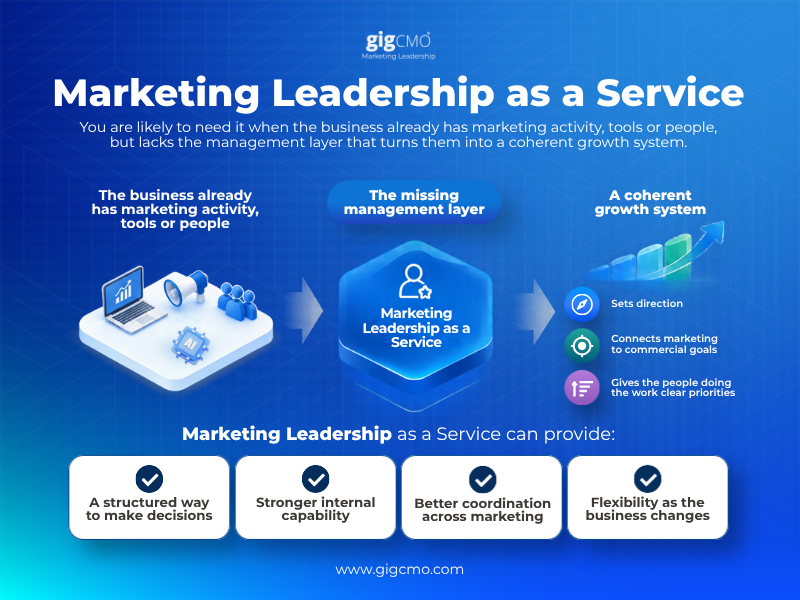
Many companies invest heavily in marketing but struggle to see measurable results. Marketing Leadership as a Service gives a business senior marketing leadership without requiring a permanent full-time executive. It sets direction, connects marketing to commercial goals and gives the people doing the work clear priorities.
You are likely to need it when the business already has marketing activity, tools or people, but lacks the management layer that turns them into a coherent growth system.
What is Marketing Leadership as a Service?
Marketing Leadership as a Service is an ongoing senior leadership role that takes responsibility for how marketing operates.
That means deciding which customers the business should focus on, how the proposition should be taken to market, what the team works on first, how marketing supports sales, and how performance is measured against commercial objectives.
For many growing B2B businesses, the need appears after founder-led marketing has taken the company through its early stages, but before there is a strong case for building a permanent senior marketing structure.
If you're recognising three or more of the following signs, it's time to consider bringing in senior marketing leadership.
1. You're Spending Money But Don't Know What's Working
Marketing budgets keep increasing, but reporting lacks clarity on return on investment or which channels actually drive revenue. You might see impressive metrics like impressions, clicks, and engagement rates, but these vanity metrics don't translate into pipeline growth or sales. Without clear attribution and performance frameworks, marketing becomes a cost centre rather than a revenue driver.
Marketing leadership introduces discipline around measurement, ensuring every pound spent ties back to business outcomes like customer acquisition cost, lifetime value, and revenue contribution.
2. Vendors or Agencies Are Running Your Strategy
External partners should execute your plan, not define your entire marketing direction. When agencies, freelancers, or consultants set a strategy, you lose control and commercial alignment. Agencies naturally optimise for their channel speciality rather than your holistic business goals, creating siloed efforts that don't compound.
Senior marketing leadership brings independent challenge and an objective perspective, ensuring external partners work within a coherent strategy you own. A Marketing Leadership-as-a-Service manages agencies with clear briefs, KPIs, and accountability structures, redirecting spend from overhead to performance-driving activities.
3. Sales and Marketing Are Working from Different Assumptions
Marketing generates leads while sales struggles to close them, or vice versa. There's no shared definition of a qualified lead, buyer journey, or revenue target. This disconnect creates friction, wasted budget, and missed opportunities.
A marketing leader specialising in aligning marketing with sales and leadership goals, establishing clear handoff processes and shared accountability. They introduce governance rhythms, such as weekly sprint reviews and monthly leadership sessions, that keep both functions aligned with the same objectives.
requires someone with enough authority to work across both functions and resolve those questions. Otherwise, each team can continue optimising its own part of the process while the pipeline problem remains.
4. Growth Has Plateaued Despite More Activity
The tactics that helped win early customers may no longer be enough. Referrals slow down, paid acquisition becomes less efficient, and the founder’s personal network cannot carry the next stage of growth. In response, the business often adds more campaigns, channels, and suppliers without revisiting its market position or go-to-market approach.
Founder-led marketing is often the right starting point. Founders understand the problem, the customer, and the story behind the business better than anyone. But as the company grows, marketing decisions become more complex and require more coordination than one person can reasonably provide alongside fundraising, product, hiring, and sales.
Marketing leadership brings an external perspective and a structured way to identify constraints. It can help the business refine its positioning, focus on the most promising audiences, choose appropriate channels, and turn isolated activity into a more deliberate growth plan.
5. Marketing Capability is Spread Across People
From our experience marketing capability often develops in stages rather than through a planned team structure. There may be a junior marketer, a freelance designer, a web developer, a content writer, and several specialist suppliers. Individually, they may all be capable. Collectively, however, they can lack direction.
Without a clear owner, the website, outbound activity, content, campaigns, and CRM can drift in different directions. Sales may complain about lead quality while marketing points to rising enquiry volume. Suppliers can meet their deliverables without anyone deciding whether the combined work supports the commercial plan.
The founder often becomes the integrator by default. Marketing Leadership as a Service can take ownership of priorities, planning, and coordination while allowing specialists to focus on execution. It also helps internal capability grow through clearer processes, documentation, coaching, and knowledge transfer.
6. AI Has Increased Output but Not Clarity
AI can make a small team much faster. However, speed can create a new problem when there is no clear decision framework.
A business can produce more options than it can sensibly evaluate. Gartner reported in 2026 that CMOs were allocating an average of 15.3% of marketing budgets to AI initiatives, while only 30% described their AI readiness as mature or fully developed.
Its respondent base was weighted towards large companies, but the lesson is useful for smaller firms: tools can expand capacity faster than processes can improve. Someone still has to decide what should be produced, why it matters, how it will be used and whether it will affect a commercial result.
7. Reporting Exists but Does Not Help Leadership Decide
Dashboards are not the same as insight. Many businesses have access to data, but still cannot answer straightforward questions: Which audiences are responding? Which messages are working? Where are opportunities dropping out of the funnel? Which investment should be increased, changed, or stopped?
When reporting is unclear, senior leaders lose confidence in marketing. Decisions become reactive, with budgets redirected based on the loudest opinion, the latest competitor move, or the most persuasive supplier presentation.
Marketing leadership turns reporting into a management tool. It establishes a small number of useful measures, clarifies ownership, and creates a regular review process linked to commercial objectives. That gives founders, boards, and leadership teams a clearer view of progress and a better basis for investment decisions.
When Does Marketing Leadership as a Service Make Sense?
A permanent CMO may be the right choice when the business has a mature growth model, a sizeable internal marketing team and a clear long-term need for full-time executive leadership.
For many startups, scale-ups and SMEs, that point comes later. They need senior marketing leadership now, but they also need flexibility in how that capability is brought into the business.
Marketing Leadership as a Service can provide:
- Senior leadership without adding permanent executive headcount: Bring experienced marketing leadership into the business without committing immediately to a full-time senior hire.
- A structured way to make decisions: Work from an established playbook that helps the leadership team decide what to prioritise, what to measure and where resources should be focused.
- Stronger internal capability: Improve the team's skills, processes and decision-making so the business becomes less dependent on external support over time.
- Better coordination across marketing: Give internal marketers, sales teams, agencies and specialist suppliers one plan, with clearer ownership and accountability.
- Flexibility as the business changes: Adjust the level of leadership and execution support as priorities, markets and internal capability develop.
This is how gigCMO's playbook-driven model works. We combine senior marketing leadership, our Business Growth Playbook, practical execution support and knowledge transfer so growing businesses can improve marketing performance without building a full senior marketing structure too early.
What Should You Do If Several of These Signs Apply?
If several of these signs feel familiar, the first step is to look at how marketing is being led today.
Who sets the priorities? Who owns the pipeline contribution? Who decides where the budget should go? Who keeps internal teams and external partners working to the same plan?
If those responsibilities are unclear or still sit mainly with the founder, the business may have reached the point where stronger marketing leadership is needed.
At gigCMO, we help startups, scale-ups and SMEs put that leadership in place through our playbook-driven Marketing Leadership as a Service model.
If you would like to discuss where your current marketing model is holding back growth, contact us.