
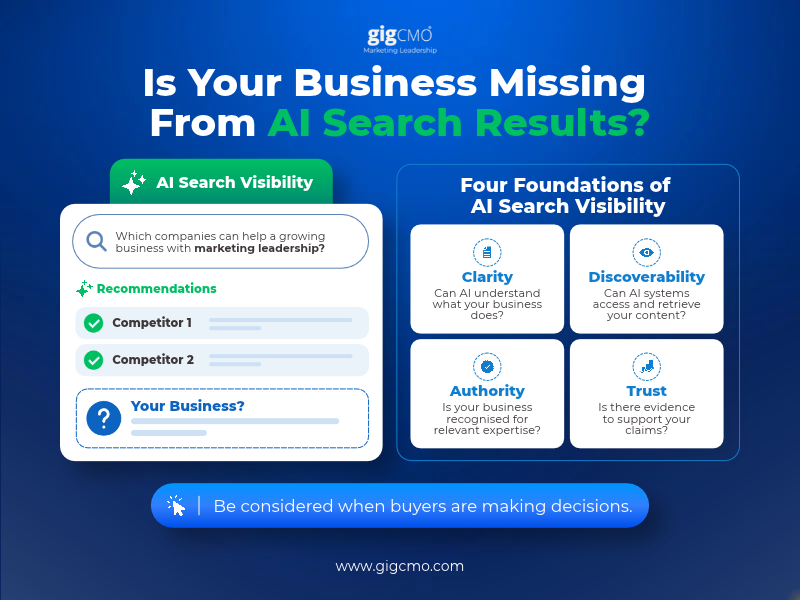
AI-powered search is changing how customers discover, research and evaluate companies. Ranking on Google is no longer the only measure of visibility. What increasingly matters is whether AI platforms recognise your expertise, reference your content and include your brand when potential customers research their options.
This creates a new challenge for business leaders. Your company may have a website, publish useful content and rank for relevant keywords, yet still be absent when prospective customers ask AI tools for advice or recommendations.
Insights from the AI Semrush Bootcamp and Brand Visibility Conference in London highlight the growing importance of four connected foundations: Clarity, Discoverability, Authority and Trust.
For founders and business leaders, these principles provide a practical starting point for adapting their marketing strategy.
What is AI search visibility?
AI search visibility is the extent to which a business, brand or its content appears in AI-generated answers, citations and recommendations when users search for information relevant to its products or services.
Traditional search engine optimisation (SEO) focuses on helping web pages appear in search results. AI search optimisation extends this work by considering whether AI systems can retrieve, understand and use information about a business when generating answers.
For example, a CEO might ask an AI assistant:
- How can a business scale marketing without hiring a full in-house team?
- What is the best way to improve B2B lead generation?
- How can a business improve marketing performance and return on investment?
- What marketing leadership support is available for a growing company?
These questions represent potential commercial opportunities.
If AI-generated answers consistently reference competitors, relevant industry publications or other providers but omit your business, you may be missing an opportunity to influence buyers during their research.
The objective is not simply to appear in more AI-generated responses. It is to become visible for the subjects and customer problems that matter commercially.
How is AI search different from traditional SEO?
Traditional SEO and AI search optimisation are closely related, but they are not identical.
SEO helps search engines discover, index and rank relevant web pages. AI-powered search experiences may retrieve information from multiple sources, combine that information into a response and cite selected references.
This means that a business can benefit from appearing in an AI-generated answer even when the user does not immediately visit its website.
It also means that conventional ranking performance alone cannot provide a complete picture of AI brand visibility.
For businesses, three changes are particularly relevant:
1. Search behaviour is becoming more conversational.
Potential buyers can describe a business problem in detail rather than searching for a short keyword phrase.
2. Buyers may receive recommendations before visiting a website.
AI-generated summaries can influence which providers a buyer decides to investigate.
3. Third-party information matters alongside website content.
Industry publications, directories, reviews and independent mentions can help establish how a brand is represented across the wider information environment.
Businesses should therefore continue investing in technical SEO while broadening their approach to content, reputation and brand authority.
The four foundations of AI search visibility
A framework built around Clarity, Discoverability, Authority and Trust.
Each addresses a different part of how a business becomes understood and represented in AI-powered search.
1. Clarity: Can AI understand what your business does?
Clarity means communicating a consistent, specific and accurate description of your business, its expertise, its customers and the problems it solves.
A business may describe itself differently across its website, LinkedIn page, business directories and external profiles.
These inconsistencies can make it harder for potential buyers and AI systems to establish a clear understanding of the company.
For example, describing a business only as a provider of "innovative growth solutions" offers little useful information.
A more specific description identifies the target market, service model and business outcome.
To improve brand clarity, business leaders should ensure their digital presence consistently explains:
This is particularly important for B2B with specialist or unfamiliar service models.
Commercial implication: If buyers cannot quickly understand why your business is relevant to their problem, additional visibility may not translate into qualified opportunities.
2. Discoverability: Can AI systems access and retrieve your content?
AI discoverability refers to whether relevant content can be found, accessed and retrieved by AI-powered search systems.
A technically sound website remains an important foundation.
Content that is blocked from retrieval, poorly organised or difficult to interpret may have fewer opportunities to contribute to AI-generated answers.
Practical priorities include maintaining accessible web pages, resolving important technical SEO issues, using descriptive page titles and organising content around clear topics.
Article structure also matters.
A page that directly answers a specific customer question provides a clearer reference than one that takes several paragraphs to explain its subject.
For example, an article targeting the question "How can businesses improve marketing ROI?" should define the problem, explain the relevant measures and provide practical guidance.
It should not rely solely on broad promotional statements about marketing performance.
Businesses should also recognise that discoverability extends beyond their own websites. Relevant industry publications and other credible sources can contribute to the information available about a brand.
Commercial implication: Content investment has limited value when the information cannot be readily accessed or understood by the systems and people conducting research.
3. Authority: Is your business recognised for relevant expertise?
Brand authority is the credibility a business develops through demonstrated expertise, useful information and recognition from relevant external sources.
In AI search, publishing a large volume of content does not automatically establish authority.
Businesses need to demonstrate why their information deserves consideration.
For B2B, authority-building activities may include:
An important principle is the need to identify a citation core: the sources AI platforms reference when answering questions about a particular topic.
This helps businesses understand which publications, websites and other sources are influencing visibility in their market.
Rather than pursuing mentions everywhere, a business can prioritise the sources that are relevant to its customers and expertise.
Commercial implication: Authority is more useful when it is concentrated around the subjects that influence purchasing decisions, rather than general brand exposure.
4. Trust: Is there evidence to support your claims?
Trust in AI search depends partly on the availability of credible, consistent and verifiable information about a business.
A company may describe itself as experienced, effective or commercially focused. Those statements are stronger when supported by evidence.
For example, a B2B marketing provider claiming to improve pipeline performance should explain its methodology and, where appropriate, provide measurable outcomes.
Useful trust signals include named expertise, clear service descriptions, genuine customer testimonials, documented results and consistent business information.
Content should also distinguish between established facts, professional recommendations and commercial opinions.
For businesses, this is an opportunity to make existing expertise more visible.
Businesses do not necessarily need to produce more content. They may need to improve the evidence, specificity and usefulness of the content they already publish.
Commercial implication: Credible information helps buyers assess whether a provider can deliver what it promises. AI visibility should support that evaluation, not replace it.
Five practical actions businesses can take now
Businesses do not need to overhaul their entire marketing operation to begin improving AI search visibility. A practical starting point involves five actions.
1. Identify commercially relevant questions. Determine what customers ask when researching the problems your business solves. Prioritise questions that indicate genuine relevance to your services.
2. Review how AI platforms represent your business. Test those questions across relevant AI search experiences. Look for brand mentions, cited sources and competing providers. Treat individual results as observations rather than definitive rankings.
3. Audit website accessibility and existing content. Address significant technical issues and improve the pages most relevant to priority customer questions.
4. Strengthen your evidence and external authority. Identify credible publications, industry sources and other channels where your expertise can be independently recognised.
5. Establish ongoing measurement and accountability. Track relevant visibility indicators, review citation opportunities and connect the findings to marketing decisions and commercial results.
The key is to focus resources where improved visibility can contribute to customer discovery and turn those opportunities to drive revenue.
Why AI search visibility matters for business growth strategy
AI search is creating another way for potential customers to discover businesses, compare options and decide which providers deserve further consideration.
For business leaders, the priority is not simply appearing in more AI-generated answers. It is making sure their company is visible for the customer problems it is best equipped to solve.
That requires clear positioning, accessible information, credible expertise and evidence that supports the business's claims.
At gigCMO, we believe AI search visibility should be part of a wider commercial strategy, connecting marketing investment to relevant customer discovery, stronger pipeline opportunities and measurable growth.
The goal is not to be mentioned everywhere. It is to be considered when the right customers are making decisions.
If your business is investing in marketing but lacks clarity on which capabilities and priorities will support growth, gigCMO can help identify where to focus next.