International expansion is one of the most powerful growth levers available to a business and one of the most misunderstood.
Many companies assume expanding into a new country is simply a matter of translating a website, hiring a local salesperson, or running ads in a new market. In reality, successful international expansion is a strategic, multi-disciplinary decision that touches every part of the business: positioning, operations, revenue model, and brand.
This blog breaks down how to create an international expansion strategy that is intentional, evidence-led, and commercially sound, based on what we see working with ambitious businesses at gigCMO.
What Is an International Expansion Strategy?
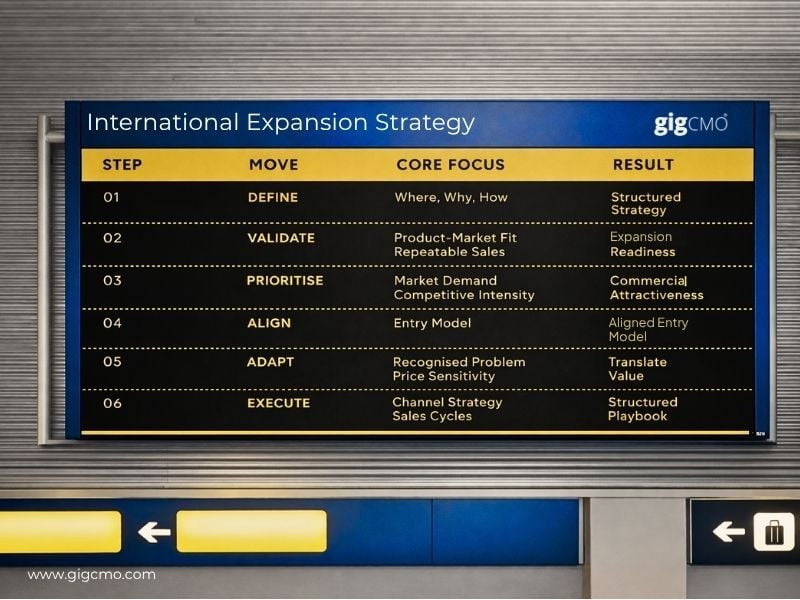
An international expansion strategy defines where, why, and how your business will enter new markets and, just as importantly, where it won't.
It aligns market opportunity with internal readiness, ensuring that expansion supports long-term growth rather than stretching the business. Without a clear strategy, companies often expand reactively, following inbound interest or competitor moves rather than a structured plan.
At its core, a strong international expansion strategy answers five fundamental questions:
- Which markets offer the strongest growth potential?
- What market entry model should we use?
- How must our product, pricing, and messaging adapt?
- Do we have the internal capability to execute and scale?
When Is the Right Time to Expand Internationally?
One of the most common questions business leaders ask is whether they are ready to expand.
International growth is rarely about size alone. We've seen smaller businesses succeed globally because they were strategically prepared, while larger organisations failed due to misalignment.
Before expanding, businesses should assess:
- Consistent product-market fit in the home market
- Repeatable sales and marketing processes
- Predictable unit economics and margins
- Leadership bandwidth to manage complexity
- Operational readiness (legal, finance, delivery, support)
Crucially, expansion should not be used as a shortcut to fix stagnation at home. If your core model isn't working domestically, scaling itinternationally will amplify the problem.
How Do You Choose the Right Market?
Market selection is where most expansion strategies succeed or fail. Many businesses default to bigmarkets without validating real demand or feasibility.
A strong market prioritisation framework typically evaluates:
- Market demand and customer pain points
- Competitive intensity and local alternatives
- Ease of doing business and regulatory complexity
- Cultural and language proximity
- Cost of acquisition and speed to revenue
At gigCMO, we use a playbook-driven evaluation framework to help clients prioritise markets based on commercial attractiveness and execution risk.
What Are the Different Market Entry Strategies?
There is no single best way to enter a new market. The right model depends on risk tolerance, speed requirements, and control needs.
Common market entry options include:
- Direct sales from headquarters
- Local partnerships or distributors
- Hiring in-market sales or marketing talent
- Joint ventures or strategic alliances
- Acquisitions or mergers
- Local subsidiaries or entities
Each approach has trade-offs between speed, cost, control, and scalability. The key is aligning your entry model with your long-term growth strategy, not just short-term revenue targets.
How Should You Adapt Your Marketing for New Markets?
A common misconception is that a strong value proposition travels unchanged.
While your core offering may remain the same, how value is perceived often differs significantly by market. Cultural norms, maturity of the category, pricing expectations, and trust signals all influence buying decisions.
Before entering a new market, businesses should assess:
- Whether the problem you solve is recognised and prioritised locally
- How customers currently address that problem
- What proof points or credibility markers matter most
- How price sensitivity compares to your home market
This doesn't mean rebuilding your brand from scratch. It means translating value, not just language. Businesses that skip this step often struggle to gain traction despite strong products.
What Are the Biggest Challenges in International Expansion?
Businesses searching online often ask, "Why do international expansions fail?" The answer is rarely about ambition and almost always about execution.
The most common challenges include:
- Underestimating cultural and behavioural differences
- Lack of local market insight
- Fragmented go-to-market execution
- Poor alignment between sales, marketing, and leadership
- Over-reliance on single hires instead of systems
- Absence of a repeatable expansion framework
These challenges are precisely why successful companies rely on structured playbooks rather than ad-hoc decision-making.
Ready to scale globally but need a solid plan? Take our Market Expansion Readiness Audit to assess your readiness and identify key areas for improvement.
How Do You Build a Go-to-Market Strategy Internationally?
International expansion fails less often because of product issues and more often because of go-to-market (GTM) misalignment.
Your GTM strategy must account for local channels, sales cycles,decision-makers, and trust-building mechanisms. What works in one country mayunderperform badly in another.
A strong international GTM strategy addresses:
- Channel strategy and route to market
- Sales enablement and local messaging
- Demand generation and brand building
- Partner alignment and incentives
- Measurement and performance benchmarks
This is where many leadership teams benefit from fractional senior marketing leadership. A Fractional CMO Service brings experience from multiplemarket entries and helps avoid costly trial-and-error.
How gigCMO Helps Businesses Expand Internationally
Our Fractional CMO Service offers businesses senior-level strategic marketing leadership without committing to a full-time hire. We bring a playbook-driven approach built from real-world international expansion experience across multiple sectors and geographies.
We support clients by:
- Assessing international market readiness
- Defining prioritised expansion strategies
- Adapting value propositions for new markets
- Designing scalable go-to-market models
- Aligning teams around clear execution plans
International expansion should accelerate growth. With the right strategy and leadership in place, it becomes a powerful driver of long-term value. If you're ready to approach international markets with clarity and confidence, it's time to talk to us.