The UK can offer significant opportunities for international B2B companies.
It is a large and established market, with access to sophisticated buyers, strong industry ecosystems and international commercial networks. However, market attractiveness alone does not prove that your business is ready to enter.
A promising conversation, an invitation to attend an event or a small number of enquiries can create the impression that demand already exists. But interest is not the same as a viable commercial opportunity.
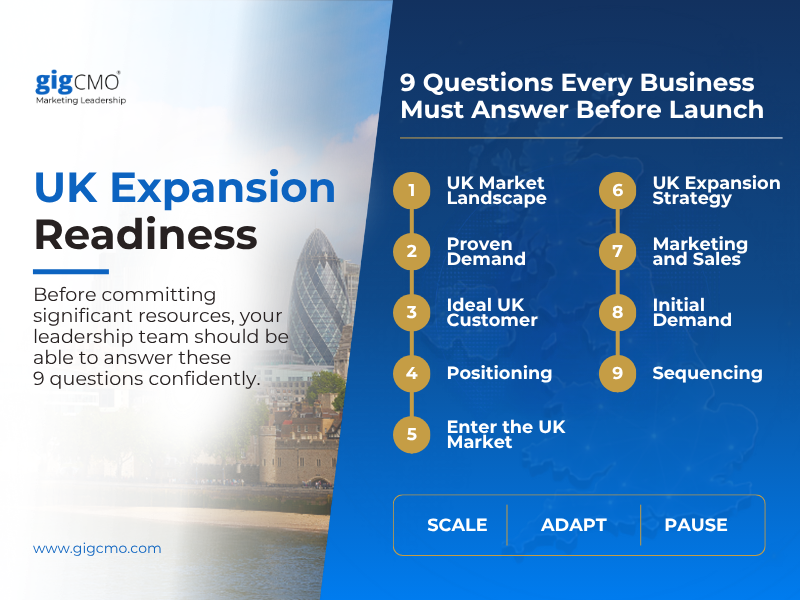
Before committing significant budget to UK hire, campaigns, partnerships or market-entry activity, your leadership team should be able to answer 9 questions.
1. Do You Understand the UK Market Landscape?
The UK is positioning itself as a premier destination for business expansion in 2026, driven by economic recovery, pro‑innovation policy, and sector‑specific investment.
Several industries are receiving particular government focus:
- Technology & Innovation: Fast-growth tech sectors include FinTech (holding roughly 10% global market share), HealthTech, CleanTech, and Artificial Intelligence.
- Financial Services: A global hub, particularly for asset management, insurance, and green finance.
- Advanced Manufacturing: Key areas include aerospace and pharmaceuticals, which are important for regional economic development.
However, understanding the market landscape requires more than identifying attractive sectors. You also need to understand the size of your specific opportunity, the competitive environment, regional differences, regulatory requirements and how buyers currently address the problem you solve.
2. Is There Proven Demand for Your Offer in the UK?
Proven demand is demonstrated by consistent, high-value engagement from relevant UK buyers. This can include validated sales, a growing qualified pipeline and measurable market traction that goes beyond general interest or occasional enquiries.
Key indicators of demand include:
- Validated sales or contracts: Signed agreements, paid pilots, closed deals or recurring revenue from UK clients.
- Qualified pipeline: A meaningful number of UK prospects with a clearly identified need, relevant budget and a credible reason to act.
- Customer acquisition cost efficiency: A realistic understanding of the cost of attracting, engaging and converting UK buyers.
- Competitive positioning: Evidence that your offer is generating specific interest when compared with existing providers or alternative solutions.
- Positive market response: Market research, buyer interviews and early commercial testing that show UK customers recognise the problem and are willing to consider your offer at an acceptable price.
Early interest is useful, but it should not be confused with proven commercial demand.
3. Who Is Your Ideal UK Customer?
Your ideal customer profile in the UK may differ significantly from your home market.
UK organisations can vary in structure, budget ownership, procurement processes, buying groups and risk tolerance. This means the segment most receptive to your offer may not be the one you initially expect.
Key factors that may affect your UK ideal customer profile include:
- Decision-making complexity: Some UK organisations involve multiple stakeholders in purchasing decisions, particularly where the investment is significant or operational risk is high.
- Formal purchasing procedures: Tendering, procurement frameworks and compliance requirements may affect how organisations assess and appoint suppliers.
- Relationship-based selling: Many UK buyers place significant value on credibility, trust, relevant evidence and confidence in the long-term relationship.
- Sensitivity to value: Buyers are likely to expect a clear commercial case, credible return on investment and evidence that the solution can be implemented effectively.
Your ideal customer should therefore be defined by more than industry or company size. It should reflect the strength of the need, access to the buying group, commercial fit and likelihood of progressing towards a purchase.
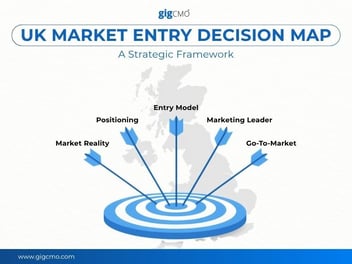
4. Does Your Positioning Resonate with UK Buyers?
Effective positioning in the UK requires clear differentiation, emotional connection, and consistent messaging to stand out in a crowded market. UK buyers are often value-conscious, requiring brands to demonstrate unique value.
Key ways to ensure your positioning resonates:
- Differentiate from competitors: Define a clear position and avoid becoming another broadly similar option in a crowded market.
- Understand customer needs: Use buyer interviews, customer feedback and market testing to ensure your value proposition reflects current UK buyer expectations.
- Ensure consistent messaging: Present a clear and consistent message across marketing, sales conversations, proposals and customer communications.
- Focus on value: Explain the commercial, operational or strategic value of your offer rather than relying primarily on features.
- Use relevant proof: Provide case studies, evidence and examples that help UK buyers understand how your offer can work in their environment.
Positioning should be tested with real buyers before it is applied across a large-scale campaign.
5. How Will You Enter the UK Market?
Your entry strategy determines your speed, cost, and risk. The UK offers multiple pathways, but choosing the wrong one can delay traction or inflate spend. A well‑defined entry model ensures you build momentum efficiently.
Key entry models to consider include:
- Direct sales: Provides greater control over the customer relationship and may be suitable for complex or enterprise solutions, although it can require more internal investment.
- Channel partnerships: Can provide access to established networks and market knowledge but requires strong alignment, clear incentives and shared ownership.
- Distributor networks: Often relevant for physical products, regulated sectors or markets that require local logistics and fulfilment.
- Pilot-first approach: Allows you to validate the offer with a small number of anchor clients before committing to wider expansion.
- Hybrid models: Combine direct market activity with selected partners, distributors or local support.
- The right entry model should provide credible access to your target buyers while allowing you to retain enough control to learn from the market.
6. Who Is Leading Your UK Expansion Strategy?
A UK expansion requires clear leadership. Without a dedicated owner, efforts risk becoming fragmented, reactive, or misaligned with local realities. The leader of your UK expansion must combine strategic vision with operational discipline, ensuring every decision supports long‑term success.
Key indicators of strong expansion leadership:
- Local market understanding: Knowledge of UK buyer behaviour, sector dynamics, competition and regulatory requirements.
- Strategic accountability: Clear responsibility for sequencing the expansion, from early demand validation through to pipeline development and scaling.
- Structured growth plan: A defined roadmap for testing the market, building traction, generating demand and deciding when to increase investment.
- Knowledge transfer: A process for sharing UK market insight with the wider team so that learning informs future decisions and execution.
The leader should have the authority to coordinate marketing, sales, delivery and senior leadership around one market-entry plan.
7. Are Marketing and Sales Aligned?
Marketing and sales alignment is critical during expansion. Misalignment leads to wasted spend, inconsistent messaging, and slow pipeline growth. A unified UK go‑to‑market approach ensures every activity supports revenue.
Key indicators of alignment:
- Shared definitions: Agreement on what constitutes a relevant UK lead, a qualified sales conversation and a genuine commercial opportunity.
- Shared KPIs: Pipeline, conversion and revenue targets that are understood and supported by both teams.
- Shared messaging: A consistent narrative from the first marketing interaction through to the sales conversation and proposal.
- Feedback loop: Sales insights, buyer objections and market responses directly inform marketing content, targeting and campaigns.
- Coordinated execution: Joint planning for events, outreach, partnerships, content and demand-generation activity.
During the early stages of market entry, alignment is also necessary to ensure that every buyer conversation contributes to market learning.
8. How Will You Generate Initial Demand?
Generating initial demand in the UK requires a precision-first, "relationship-driven" approach rather than high-volume marketing, particularly focusing on credibility with targeted, high-value buyers.
High‑impact early demand tactics:
- High-impact early demand tactics include:
- Warm introductions: Use investors, partners, advisers and existing customers with relevant UK networks.
- Industry events: Speak, host roundtables, arrange meetings or run demonstrations at events attended by your target buyers.
- Strategic partnerships: Work with complementary providers, trade organisations or sector bodies that can support credibility and access.
- Targeted outbound: Use personalised outreach to a narrow and clearly defined ideal customer profile.
- Thought leadership: Publish UK-specific insights, frameworks or commentary that demonstrate an understanding of the market and support buyer conversations.
Your initial demand-generation activity should be designed to test assumptions and create qualified conversations, not simply produce reach or visibility.
9. Are You Sequencing Your Expansion Correctly?
Sequencing is one of the most critical and most overlooked components of a successful UK expansion. Even strong companies fail when they invest in the right activities at the wrong time. A disciplined, evidence‑based sequence reduces risk, accelerates learning, and ensures you only scale once the fundamentals are proven.
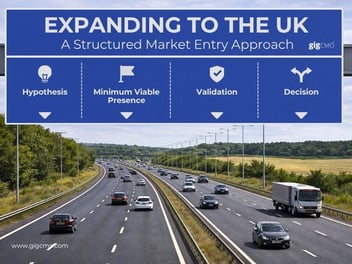
- Market Hypotheses: Clear assumptions about your UK customer, their pain points, pricing expectations, and buying behaviour. These hypotheses guide your early research and outreach.
- Achieved Minimum Viable Product (MVP): A UK‑ready version of your offer, whether product, service, or proposition, that is strong enough to test with real buyers but flexible enough to refine.
- Validation, Evidence‑Based: Real‑world proof that your hypotheses are correct. This includes paid pilots, early revenue, repeatable sales conversations, and measurable UK buyer engagement.
- Expand or Exit Decision: A strategic checkpoint where leadership evaluates whether the evidence supports scaling, requires pivoting, or suggests pausing the expansion entirely.
Structuring Your UK Market Entry
If your organisation is considering entering the UK market, the most valuable first step is to ensure that these questions have been answered before significant activity begins.
The aim is not to eliminate every uncertainty. It is to identify the most important assumptions, test them in the right order and avoid making major commitments before sufficient commercial evidence exists.
At gigCMO, we work with B2B companies to structure and execute their UK market-entry strategy.
We provide the marketing leadership and execution capability needed to define positioning, align teams, establish routes to demand and build the internal capability required for long-term growth.
If you are preparing for UK expansion or are already active in the market but facing uncertainty, contact gigCMO to assess your current approach and define the next steps.