.jpg?width=800&height=600&name=20260521%20-%20Blog%20What%20Worked%20in%20One%20Market%20Wont%20Work%20in%20Another%20-%20gigCMO%20-%20Op3%20(1).jpg)
A business expands because something is already working.
The proposition has traction. Customers are buying. The sales story makes sense. The marketing may not be perfect, but it has created enough momentum to prove there is demand.
So the natural assumption is that the same approach will work in a new market like the UK. But what created demand in one country may not create the same response in a new market.
Successful market expansion is not about copying what worked before. It is about understanding what must change, what should stay consistent, and how to adapt your go-to-market strategy without losing the core of your business.
Before Entering a New Market, Assess Whether You Are Ready to Scale
Before any B2B company expands internationally or enters a new regional market, it must first assess its internal readiness to scale.
Market opportunity matters, but expansion also tests the strength of the business itself. If the existing growth model is inconsistent, heavily founder-led, or difficult to repeat, entering a new market can make those weaknesses more visible.
Key indicators of readiness include:
Proven Market Traction in the Core Business
The business should have clear evidence that its offer works in its existing market. This means proven demand, a defined customer segment, a clear value proposition and some repeatable route to revenue.
If the core business is still dependent on one-off opportunities, personal relationships, or the founder being involved in every commercial conversation, expansion can become harder than expected. The company may end up trying to prove the model and enter a new market at the same time.
Strong market traction gives the business something to adapt. Without it, expansion can become an expensive experiment.
Operational Capacity to Deliver at Scale
The business needs the systems, people and processes to serve more customers without reducing quality or overloading the team.
Winning customers in a new market is only useful if the business can deliver well. Poor delivery damages trust quickly, especially when the brand is not yet established locally.
Operational readiness includes onboarding, account management, customer support, reporting, and internal coordination. If these areas are already stretched, expansion may create more pressure than growth.
Financial Health and Resilience
Expansion usually requires investment before it creates reliable returns.
There may be costs linked to market research, positioning, marketing, sales activity, partnerships, events, hiring, legal advice, localisation and longer buying cycles. The first phase of market entry is often about learning, testing and building credibility, not immediate revenue.
Without financial resilience, companies often underinvest, stop too early, or change direction before the market has been properly tested. A strong expansion plan should be ambitious, but it also needs to be commercially realistic.
Leadership and Organisational Bandwidth
Expansion needs clear ownership and consistent decision-making. Leadership must have the capacity to manage a new market without losing focus on the core business.
The business should be clear on who owns the strategy, execution, budget, and performance tracking. It also needs to know which decisions can be made locally, and which must stay centralised.
Without this clarity, market entry can become fragmented. Marketing runs in one direction, sales in another, operations are brought in too late, and leadership only intervenes when results are already behind expectation.
Internal readiness does not guarantee success, but it helps ensure the business is not trying to scale a model that is not yet strong enough to travel.
Why Businesses Assume Their Existing Marketing Will Travel
Businesses assume existing marketing will translate seamlessly to new regions, demographics, or audiences, primarily due to the allure of cost efficiency, overconfidence in a universally appealing product, and the simplicity of standardised branding.
The temptation to reuse winning campaigns often blinds organisations to the stark realities of market expansion.
This practices is driven by several key factors:
1. The Trap of Cost Efficiency
Expanding into a new market is expensive. To reduce financial risk, businesses often try to reuse existing marketing assets, including website copy, sales decks, email sequences, advertising messages, case studies and campaign materials.
Some consistency is useful. A business should not reinvent itself every time it enters a new market. But efficiency becomes a problem when it replaces market understanding.
Reusing assets may save money in the short term, but if the message does not resonate, the business pays for it later through weak engagement, poor conversion and slow pipeline development.
2. Overconfidence in the Existing Proposition
Previous success can create a false sense of certainty.
If customers in one market understand the problem, value the offer and are willing to buy, it is easy to assume that buyers elsewhere will respond in the same way.
But customers do not evaluate value in isolation. They evaluate it against their local context, alternatives, priorities, budgets, risks and expectations.
A proposition that feels urgent in one market may feel optional in another. A benefit that drives action in one region may not be the strongest buying trigger in the UK. A message that sounds confident in one country may feel exaggerated or unclear to a different audience.
The offer may still be strong. The framing may simply need to change.
3. The Illusion of a Borderless Digital Market
Digital platforms make markets look more connected than they really are.
A website can be accessed from anywhere. LinkedIn content can reach international audiences. Paid campaigns can be launched across regions. Search demand can appear global.
But access is not the same as relevance. Different markets still have different buying behaviours, trust signals, decision processes and expectations. B2B buyers may use the same platforms, but they do not necessarily respond to the same message.
This is why international expansion requires more than visibility. It requires local relevance.
Why the UK Market May Respond Differently
The UK can look familiar, especially for businesses coming from other English-speaking markets. The language is similar, the business environment is mature, and the market is accessible.
But familiarity can be misleading. The UK is a competitive and trust-driven B2B market. Buyers are often comparison-led, commercially cautious and sensitive to broad or exaggerated claims. They need to understand not only what you offer, but why it is relevant to their situation, why now, and why they should trust you.
This matters for messaging. A proposition that works well elsewhere may need to be sharpened for the UK. Claims may need to be more specific. Proof points may need to be more credible. Content may need to be more educational. Sales conversations may need a stronger commercial grounding.
UK buyers may also expect evidence that you understand the local market. This could include relevant case studies, local partnerships, sector knowledge, advisory credibility, customer references or thought leadership that speaks directly to their context.
Without these signals, even a strong business can appear distant, generic or unproven.
Market Expansion Requires Strategic Localisation
Localisation is often misunderstood. Localisation is strategic not tactical. It asks how buyers in the new market think, compare, trust and decide.
For B2B companies, this involves several connected areas.
1. Adapting to Complex Buyer Behaviour
Unlike B2C, B2B sales involve complex purchasing decisions made by multiple stakeholders (e.g., procurement, legal, C-suite, and end-users). The structure and influence of these stakeholders vary by industry and even region.
The typical regions in the UK that B2B companies consider include nine regions of England: North East, North West, Yorkshire and the Humber, East Midlands, West Midlands, East of England, London, South East, and South West.
Additionally, Scotland, Wales, and Northern Ireland are also recognised as distinct regions within the UK.
These regions are important for B2B strategies as they may have different market dynamics, customer preferences, and regulatory environments. Your sales strategy must map directly to the specific decision-makers, priorities, and internal politics relevant to the target market.
2. Securing Localised Proof and Credibility
B2B buyers are risk-averse, completing 67%-72% of their purchasing journey before ever contacting a vendor. They want to see proof of success that directly applies to their market. You cannot simply rely on case studies from your home country; you must build local case studies, gather regional testimonials, and establish third-party partnerships to earn immediate trust.
3. Adjusting the Go-To-Market (GTM) Strategy
The channels and digital platforms your buyers use to research solutions differ globally. Effective market expansion requires understanding how local prospects discover vendors and consume information, so you can tailor your content and distribution accordingly.
What Businesses Should Do Before Entering the UK Market
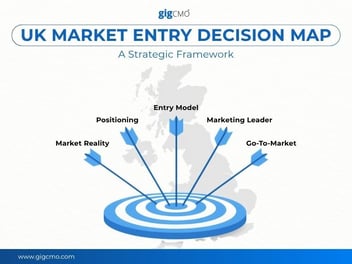
Before launching campaigns or increasing activity, businesses should step back and answer five strategic questions.
1. What is the Real Market Opportunity?
Do not rely only on market size. A large market is not automatically an accessible market.
You need to understand which segments are most likely to buy, why they would buy, and what would trigger action. The goal is not to appeal to the whole market. The goal is to identify the right entry point.
2. Which Customer Pain Points Are Strongest in the UK?
The pain may be similar, but the priority may differ. In one market, customers may buy because they want speed. In another, they may buy because they want certainty, cost control, compliance, capability, efficiency or competitive advantage.
Strong market entry depends on knowing which pain point matters most to the buyer you are targeting.
3. How Should the Proposition Be Adapted?
The product or service may stay the same, but the framing may need to change.
This could involve adjusting the value proposition, proof points, use cases, pricing logic, service model or offer structure.
The aim is not to dilute the proposition. It is to make it easier for the new market to understand why it matters.
4. What Trust Signals Are Required?
In a new market, you start with less inherited credibility. You may need local testimonials, partnerships, thought leadership, case studies, advisory relationships, sector credibility or visible leadership content.
These trust signals help bridge the gap between interest and confidence.
5. What Should Be Sequenced First?
Not everything should happen at once. Many expansion efforts fail because teams try to launch every channel, message and campaign simultaneously.
A stronger approach is to sequence activity based on commercial priority.
First, clarify the market. Then sharpen positioning. Then, validate messaging. Then build visibility. Then activate demand.
Planning to Expand into the UK?
If your business is looking to expand and grow in the UK, our workshop is designed to help you assess market readiness, sharpen your positioning, identify the right growth priorities, and build a practical go-to-market plan for UK expansion.
Join our UK Growth Expansion Workshop to clarify what needs to change, what should stay consistent, and how to enter the UK market with a stronger commercial strategy. Register your interest here.