
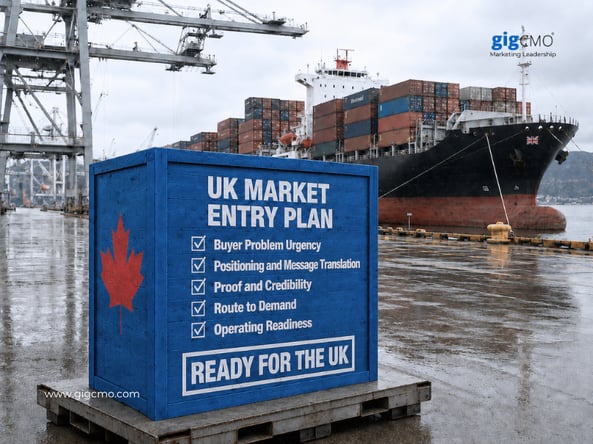
Expanding into the UK can look straightforward from a Canadian perspective.
There is a shared language, a familiar business culture and often an existing network of contacts or early interest. It is easy to assume that what works in Canada will translate with only minor adjustment.
In practice, the challenge is not access to the market. The challenge is clarity about how to enter it effectively.
Companies often move quickly into visible activity without first testing whether their assumptions hold true in a UK context. They invest in campaigns, partnerships, outreach or local support before confirming whether the right buyer, problem, message and proof are aligned.
Before committing spend, leadership needs to validate the assumptions underlying the plan.
Why UK Market Entry Should Not Start with Activity
Many companies start their UK expansion by focusing on marketing activity.
They localise the website. They prepare a campaign. They ask for introductions. They explore partnerships. They attend events. They start thinking about hiring or agency support.
None of these actions is wrong. The problem is that they often happen before the business has answered the more important questions.
The Questions That Should Come First
Before serious UK spend, a company needs to know who the first UK buyer segment is, what problem is urgent enough for that segment to act on now, whether the Canadian value proposition translates into UK buyer language, what proof a UK buyer will need before they trust the company, which route to demand is most likely to create qualified conversations and whether the business can respond properly if UK interest appears.
These questions are not theoretical. They determine whether UK activity creates evidence, pipeline and confidence, or simply creates motion.
A UK market entry plan is only as strong as the assumptions beneath it.
A Practical UK Market Entry Plan Starts with Validation
A practical UK market entry plan should not begin with a full-scale campaign. It should begin with structured validation.
The goal is not to prove that the UK is attractive in general. The goal is to understand whether the company has a specific, credible and commercially useful route into the market.
That requires five areas of validation:
- Buyer problem urgency
- Positioning and message translation
- Proof and credibility
- Route to demand
- Operating readiness
Each area answers a different risk question. Together, they show whether the business is ready to spend, adjust, narrow the market entry approach or pause.
1. Validate Buyer Problem Urgency
The first question is not whether the product or service is useful.
The better question is whether the problem is urgent enough for a UK buyer to act now.
Canadian companies often assume that because a problem exists in Canada, it will matter in the same way in the UK. Sometimes it does. Often, it does not.
The UK buyer may describe the problem differently. They may have different budget pressure, procurement expectations, compliance concerns, competitive alternatives or internal decision processes.
What Strong Buyer Urgency Looks Like
Strong validation is not polite interest. It is not a buyer saying, “That sounds useful” or “Let’s stay in touch.”
Stronger evidence appears when UK buyers can explain the problem in their own words. They understand the cost of doing nothing. They know who owns the decision. They can compare the issue against other priorities. They are willing to explore what solving it would require.
That is when the market entry conversation becomes more commercially meaningful.
What Weak Buyer Urgency Looks Like
Weak evidence often feels encouraging at first. People agree that the offer is interesting. They accept that the problem exists. They may take a meeting or ask for information.
But there is no clear urgency, no budget owner, no defined next step and no evidence that the problem is moving up the priority list.
That is not enough to justify serious UK spend.
2. Validate Whether the Canadian Proposition Translates
The second area to validate is positioning.
This is not about changing Canadian spelling into British spelling. It is not simply a language exercise. It is about whether the value proposition lands with UK buyers in a way that is clear, credible and relevant.
A company’s Canadian story has usually been shaped by Canadian customers, competitors, proof points and category expectations. UK buyers may not interpret the same story in the same way.
A claim that feels differentiated in Canada may sound generic in the UK. A customer example that feels impressive in Canada may need more context for a UK audience. A category label that works in North America may not match how UK buyers search, compare or buy.
The Test Is Clarity, Not Preference
The question is not whether UK buyers like the message.
The better question is whether the message helps the right buyer understand three things quickly:
- What problem does the company solve?
- Why is the company credible?
- Why is the conversation worth having now?
- Do you understand this market?
- Have you worked with companies like us?
- Can you support us properly?
- Are your claims relevant in our context?
- What reduces the risk of choosing you?
- Proceed if the evidence is strong.
- Narrow if one segment or route stands out.
- Adjust if the opportunity is valid but needs refinement.
- Pause or stop if the case is not yet strong enough.
If the message does not do that, the issue may not be the offer. The issue may be translation, framing or market relevance.
3. Validate Proof and Credibility
Canadian proof matters. But it does not always travel cleanly.
A company may have strong Canadian customers, investor backing, domestic case studies, sector experience or impressive growth. These are useful credibility signals. But a UK buyer may still ask a different set of questions.
Why UK Buyers Need Risk Reduction
For a UK buyer, choosing a new entrant can feel risky. The company may be credible elsewhere, but unfamiliar locally. That does not make the company unsuitable. It does mean the proof needs to work harder.
A Canadian business does not need a long UK client list before entering the market. But it does need to know which proof points reduce perceived risk.
Useful proof may include comparable customer examples, sector-specific outcomes, third-party validation, relevant certifications, partner credibility, operational readiness, founder expertise or evidence from early UK conversations.
The objective is not to overclaim. It is to make the buyer feel that the company is credible enough to be considered seriously.
4. Validate the First Route to UK Demand
Once the buyer segment, problem, message and proof are clearer, the next question is the route to demand.
This is where many companies jump too quickly into channel decisions.
They ask whether they should run campaigns, use LinkedIn, attend events, build partnerships, rely on introductions or hire sales resource. These are useful options, but the right route depends on the buyer and the stage of market learning.
Early Demand Generation Should Be Designed for Learning
The first route to demand does not need to scale immediately. In many cases, it should be designed to create learning before volume.
The company needs to understand which conversations open, which objections appear, which proof points matter, which buyer roles respond and which route creates the strongest next step.
For some companies, founder-led outreach may be the right starting point. For others, strategic introductions, partner conversations, webinars, sector associations, account-based campaigns or targeted content may be more suitable.
The question is not, “Which channel can generate the most activity?”
The better question is, “Which route will help us learn fastest from the right UK buyers?”
5. Validate Operating Readiness
Even if UK demand exists, the business must be ready to respond.
Market entry is not only a marketing question. It is also an operating question.
A company needs to know who owns UK follow-up, how quickly the team can respond, whether sales materials are ready, whether pricing and commercial terms make sense, whether customer support can handle UK expectations and whether the company can learn from early conversations.
Demand Is Only Useful If the Business Can Handle It
Early interest can be wasted if the operating model is not ready.
If follow-up is slow, the opportunity weakens. If objections are not captured, the message does not improve. If sales conversations are not reviewed, the leadership team loses valuable market intelligence. If the team cannot respond across time zones or explain delivery clearly, buyer confidence falls.
This is why validation needs a weekly management rhythm.
Leadership should be reviewing what the market is saying, not just what the team has done.
Evidence Should Lead to a Management Decision
Validation is not about slowing growth. It is about making better decisions.
After a focused validation period, leadership should be able to choose a clear path.
This discipline separates meaningful market learning from unfocused activity.
The Practical Starting Point
A strong UK entry begins with a focused validation sprint. Test a defined segment, refine the message, check the proof and learn from early conversations. Review progress weekly and decide the next step based on evidence.
If you want a clearer view of how to structure this process and avoid common mistakes, attend the webinar, Your UK Market Entry Plan: What to Validate Before You Spend, on Thursday, 16 July 2026.



.png?width=352&name=20260616%20-%20Article%20Which%20UK%20Buyer%20Segment%20Should%20You%20Test%20First%20-%20gigCMO%20-%20Op5%20(2).png)