
For UK businesses, international expansion no longer requires setting up expensive subsidiaries before testing a new market. Remote work infrastructure, digital sales models, and cross-border payment platforms have dramatically lowered the barrier to entry.
However, easier access does not mean lower risk.
Choosing the wrong country can mean regulatory friction, unexpected employment costs, limited demand, or cultural misalignment. For UK businesses looking outward in 2026, here's how to evaluate new markets and what should be validated before committing significant budget or resources.
What to Look for When Evaluating a Country for Expansion
Here are the key areas to evaluate when expanding into a new country:
-
Customer demand: Is there a clearly defined buyer segment with a sufficiently urgent problem, available budget and willingness to consider an overseas supplier?
-
Positioning and competitive fit: Will the current proposition resonate in the market, and can the business demonstrate a clear advantage over local and international alternatives?
-
Route to demand: Can the business reach decision-makers and create qualified commercial conversations through direct sales, partnerships, distributors, digital campaigns or industry networks?
-
Commercial viability: Do the expected sales cycle, acquisition costs, pricing and delivery requirements support a viable business case?
-
Operational and regulatory readiness: Can the organisation meet local legal, tax, employment, product and service requirements while supporting new customers effectively?
Five Markets UK Businesses May Consider in 2026
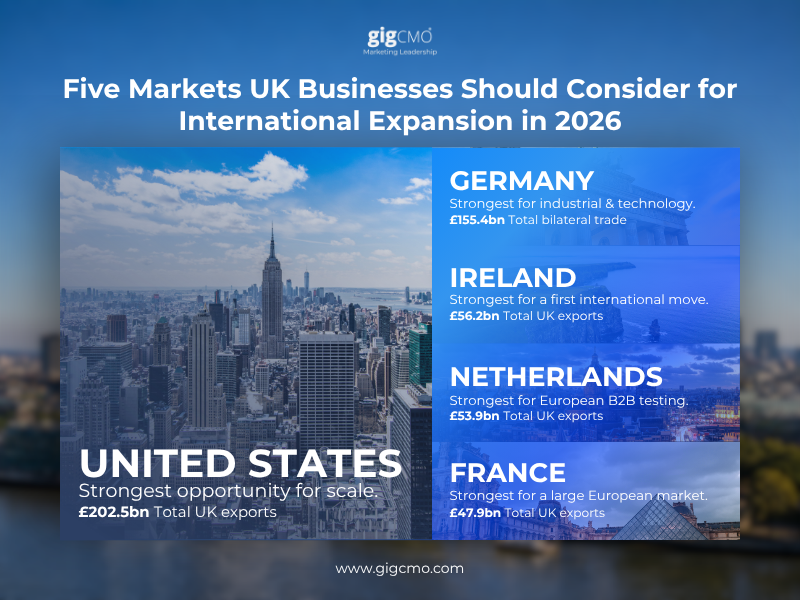
These markets offer different types of opportunity. Some provide scale, some offer a more accessible first step, while others are particularly relevant to industrial, technology or service-led businesses.
They should be treated as markets to evaluate rather than automatic recommendations. The right choice will depend on the target customer, the strength of the proposition, the route to demand and the business’s ability to deliver.
1. United States
Strongest opportunity for scale.
The United States offers the greatest scale for many UK businesses. It is the world's largest economy and the UK's largest export market, with £202.5 billion in total UK exports during the four quarters to Q4 2025. Services accounted for £142.8 billion, including substantial demand for professional and management consulting, financial services and other business services.
The opportunity is particularly strong for businesses in B2B technology, software, professional services, financial services, healthcare, life sciences, specialist engineering and differentiated customer products.
The scale of the opportunity is also the main source of complexity. The US is not one uniform market. Regulation, sector concentration, competition, customer expectations and routes to market vary significantly between states. UK government guidance recommends approaching each state as a distinct commercial market.
A UK business should select a priority state, sector and buyer group rather than targeting the whole country. It should then test whether its positioning is sufficiently differentiated, whether buyers accept UK evidence and references, and whether the route to demand can produce a qualified pipeline at a viable cost.
2. Germany
Strongest opportunity for industrial and technology-led businesses.
Germany offers substantial opportunities for UK businesses with strong technical, industrial or technology propositions. Demand is being driven by digital transformation, automation, manufacturing efficiency and decarbonisation.
The commercial relationship between the two countries is significant. Total trade in goods and services between the UK and Germany reached £155.4 billion in the four quarters to the end of Q1 2026, an increase of 3.9% compared with the previous year.
Germany’s continued digitisation is creating opportunities across business models, manufacturing processes, digital marketplaces, future mobility and supply chains.
Demand is particularly strong in areas where UK businesses have established capability, including artificial intelligence, cybersecurity, the Internet of Things, big data, consumer goods and food and drink.
The market is especially relevant for businesses in industrial technology, enterprise software, advanced manufacturing, professional services, engineering, renewable energy and digital transformation.
Germany also benefits from a highly developed economic framework, strong infrastructure, a skilled workforce and established legal protections. Its major international trade shows can provide UK businesses with access to both German and international buyers.
However, Germany remains a demanding market. German-language capability, relevant certifications, local relationships and detailed evidence of performance may be important. Buying decisions can also take longer, particularly in industrial, technical or regulated sectors.
3. Ireland
Strongest opportunity for a first international move.
Ireland is one of the most practical markets for UK businesses beginning international expansion. Geographic proximity, a shared business language and familiar commercial practices can make customer research, relationship building and early sales activity more accessible.
The UK and Ireland have a substantial and well-established commercial relationship. UK exports to Ireland reached £56.2 billion in the four quarters to the end of Q4 2025, making Ireland the UK’s third-largest export market and accounting for 6.0% of total UK exports.Total trade in goods and services between the two countries reached £90.9 billion in the four quarters to the end of Q1 2026.
Ireland may be particularly relevant for technology businesses, professional-service firms, specialist suppliers and companies serving construction, life sciences, medical technology, agritech, infrastructure, offshore wind and renewable energy.
Its relative familiarity does not remove the need for a clear commercial case. The domestic market is smaller than the US or Germany, and competition can be strong in sectors with a high concentration of multinational businesses.
4. Netherlands
Strongest opportunity for testing European B2B demand.
The Netherlands offers a highly international and commercially accessible environment for UK businesses considering expansion into Europe. Its proximity to the UK, widespread use of English and internationally focused business culture can make customer research, relationship building and early market testing more straightforward than in many larger European markets.
The commercial relationship is substantial. UK exports to the Netherlands reached £53.9 billion in the four quarters to the end of Q4 2025, making it the UK's fourth-largest export market and accounting for 5.8% of total UK exports.
The market is particularly relevant for UK businesses operating in B2B technology, professional services, logistics, financial services, renewable energy and sustainable infrastructure. UK services exports to the Netherlands reached £26.3 billion over the same period, including £5.7 billion in technical and trade-related services and £5.6 billion in professional and management consulting services.
The Netherlands is also widely regarded as a major gateway to Europe. Its transport infrastructure, international business environment, and access to the European mainland can make it a useful market for testing products, services and positioning before wider regional expansion.
However, entering the Netherlands does not automatically create demand across the rest of Europe. Each market has its own buyers, competitors, regulations and commercial expectations.
5. France
Strongest opportunity for access to a large, sophisticated European market.
France is one of the UK's largest and most established commercial markets. Its proximity to the UK, large population and strong industrial base make it a credible option for businesses seeking growth in Europe.
UK exports to France reached £47.9 billion in the four quarters to the end of Q4 2025, making France the UK's fifth-largest export market and accounting for 5.2% of total UK exports.
Services form a significant part of that relationship. UK services exports to France totalled £23.8 billion over the same period. The largest categories included financial services, technical and trade-related business services, professional and management consulting services, and computer services.
This creates a strong opportunity for UK businesses in professional services, technology, financial services, consulting, engineering and other specialist B2B sectors. France also offers substantial demand across aerospace, automotive, energy, transport, life sciences, agriculture and food.
France is a market where language, localised messaging and commercial relationships can materially affect credibility. UK businesses should not assume that an English-language proposition or UK proof points will transfer without adaptation.
What Resources Are Available to Help UK Companies Go Global?
The UK has a well-developed ecosystem of government support, trade agreements, export finance tools and advisory services designed to reduce risk and accelerate international growth.
Here are the key resources UK companies should consider:
Department for Business and Trade (DBT):
The Department for Business and Trade provides market intelligence, export guidance and access to international trade advisers. Businesses can access country-specific insights, trade missions and support navigating trade agreements.
UK Chambers of Commerce:
Chambers of Commerce offer practical, hands-on support for businesses trading internationally, including export documentation, compliance guidance and networking opportunities.
Funding and Grants:
Regional Growth Hubs and business advisers can provide information on available grants, innovation funding and export support programmes that may help offset the costs of international expansion.
UK Export Finance (UKEF):
UK Export Finance provides government-backed guarantees, insurance and working capital support to help businesses secure and deliver international contracts with greater confidence.
From Market Interest to a Commercial Entry Decision
Government guidance, trade bodies and professional advisers can help businesses understand regulations, documentation and available support.
The commercial decision still rests with the leadership team. Before committing to a country, the business must determine:
- Which customers it will pursue
- Why those customers should buy
- How the proposition needs to change
- How demand will be generated
- What route to market is viable
- What evidence will justify further investment
- Whether the organisation is ready to deliver
gigCMO provides the Marketing leadership as a Service and execution needed to structure that process.
We help businesses assess market opportunities, select priority customer segments, refine positioning, test routes to demand and build a commercially grounded market-entry plan before committing significant budget or internal resources.
The right next market is not necessarily the largest, closest or most familiar.
It is the market where customer need, commercial fit, access and organisational readiness provide the strongest basis for sustainable growth.
If you're considering expanding internationally and want a clear, structured approach, contact gigCMO today to discuss how we can support your global growth strategy.

.jpg?width=352&name=20260521%20-%20Blog%20What%20Worked%20in%20One%20Market%20Wont%20Work%20in%20Another%20-%20gigCMO%20-%20Op3%20(1).jpg)