
The UK offers a substantial commercial market for Canadian businesses. According to the UK Department for Business and Trade, the country had approximately 5.7 million private sector businesses at the start of 2025.
Trade between Canada and the UK continues to grow, with bilateral trade in goods and services reaching £35.3 billion in the four quarters to the end of Q1 2026, an increase of 19.9% compared with the previous four quarters.
However, market size and existing trade relationships do not guarantee demand for an individual business. The challenge is identifying where genuine opportunities exist and how to convert them into customers.
What Should a UK Market Entry Strategy Include?
A UK market entry strategy should establish who your potential customers are, why they would purchase your offering, how you can reach them and what evidence supports further investment.
For businesses evaluating expansion, five areas deserve particular attention: customer demand, value proposition, commercial evidence, routes to market, and operational readiness.
All of these provide a framework for determining where opportunities exist and how to pursue them.
1. Identify Your UK Customers and What Drives Them to Buy
Before entering the UK market, you need to understand which businesses are most likely to need your product or service.
Your existing customers in Canada may provide a useful starting point, but UK businesses could have different challenges, priorities, and purchasing processes.
Consider a company offering software that helps businesses reduce cloud computing costs.
It might initially target UK technology companies. However, some already manage their cloud expenditure effectively, while others struggle with rising costs and lack the expertise to address them.
The second group may represent a stronger commercial opportunity because there is a problem requiring attention.
This is where buying triggers become important. These are circumstances that encourage customers to act, such as increasing costs, regulatory changes, or operational inefficiencies.
To identify potential UK customers, consider three questions:
- What problem are they facing? Identify challenges your offering can solve.
- Why would they buy now? Understand what makes addressing the problem a priority.
- Who makes the purchasing decision? Identify the stakeholders responsible for evaluating and approving solutions.
Market research and direct customer conversations can help validate these assumptions.
The objective is to focus commercial resources on customer segments with a genuine reason to buy.
2. Adapt Your Value Proposition to UK Buying Priorities
A successful product in Canada may offer the same benefits in the UK, but those benefits must be communicated in a way that reflects local buying priorities.
Different stakeholders assess value differently, even within the same organisation.
Consider a Canadian manufacturer introducing energy-efficient lighting solutions to UK businesses.
Its proposition may focus on sustainability and reduced energy consumption. However, a finance director may be more interested in installation costs and return on investment. An operations director may prioritise minimal disruption, while a technical director may focus on compatibility and reliability.
Each stakeholder is evaluating the same product against different business requirements.
A strong value proposition connects the offering to the outcomes that matter to the people influencing the purchase.
Businesses should therefore examine:
It is equally important to test these messages with prospective UK customers.
Positive feedback during an introductory meeting does not necessarily indicate purchasing intent. Businesses need to understand whether prospects recognise a need, have the budget, and are prepared to consider changing suppliers.
Effective positioning helps buyers understand why an offering is relevant to their business and worth evaluating.
3. Establish Commercial Evidence Before Committing Investment
International expansion requires investment in people, operations, partnerships, and customer acquisition.
The challenge for business leaders is determining when the available evidence justifies those commitments.
Early conversations, positive feedback, and introductions can indicate market interest. However, interest alone does not establish whether customers are willing to purchase.
For example, a Canadian workplace safety technology provider may discover that UK businesses recognise the importance of its solution.
However, those businesses may already have established systems, existing suppliers and processes designed around UK health and safety requirements.
To demonstrate commercial potential, the provider must establish why customers would adopt an alternative and what measurable improvement it offers.
Before making significant investments, businesses should seek evidence of:
The evidence required will depend on the sector and business model.
For leadership teams, the priority is connecting investment decisions to measurable commercial progress.
Rather than committing resources based on assumptions, establish what needs to be proven before taking the next step.
4. Identify the Most Effective Route to UK Customers
Having a competitive offering is only one part of UK market entry. Businesses also need a reliable way to reach potential customers.
There are several possible routes to market, including direct sales, distribution partnerships, strategic alliances and digital demand generation.
The right approach depends on how UK customers discover, evaluate and purchase solutions.
For example, a technology provider may benefit from working with established UK managed service providers that already serve its target customers. A manufacturer may require distributors or installation partners with relevant industry relationships.
Other businesses may find that direct engagement with decision-makers provides greater control over the sales process.
When evaluating routes to market, consider the cost of customer acquisition, access to decision-makers, sales cycle, and level of control over customer relationships.
A partnership can create access to a market, but it does not guarantee sales.
The commercial priority is establishing a route that can consistently generate qualified opportunities, rather than relying solely on introductions or initial market visibility.
5. Use AI to Strengthen UK Market Research and Planning
Artificial intelligence can support international expansion by helping businesses organise research, examine potential customer segments, and investigate commercial assumptions.
Tools such as ChatGPT, Claude, Gemini, and Microsoft Copilot can assist with preliminary competitor analysis, customer research and proposition development.
For example, a business can use AI to identify potential UK customer segments, explore their likely purchasing priorities and develop questions for customer interviews.
A structured approach is more useful than conducting disconnected searches.
Businesses can organise their AI-assisted research around five areas:
|
Research area |
Focus |
|
Business model |
How the existing offering could operate commercially in the UK |
|
Value proposition |
What matters to UK customers and how the offering addresses their needs |
|
Customers |
Target segments, decision-makers, and buying triggers |
|
Routes to demand |
Sales channels, strategic partnerships and customer acquisition |
|
Commercial proof |
Evidence required to demonstrate demand and justify investment |
AI can also help assess how clearly a business communicates its offering across digital channels, including information that prospective customers may encounter through AI-powered search.
However, AI-generated findings should be verified against reliable sources and direct market feedback.
Its role is to support faster, more structured research. It cannot replace customer conversations or demonstrate genuine purchasing intent.
6. Turn Market Research into a Practical Expansion Plan
Research only creates commercial value when it informs decisions and actions.
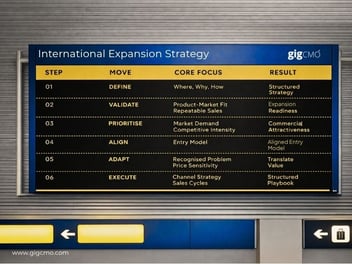
Once a business has identified potential customers, tested its proposition, and evaluated routes to market, leadership needs to determine where to focus resources.
A practical expansion plan should define:
For example, before recruiting a local sales team, a business may choose to test whether its offering generates qualified opportunities through direct outreach or channel partnerships.
The findings can then inform recruitment, marketing investment and operational decisions.
This approach gives leadership greater visibility over progress and reduces the risk of investing heavily before establishing a credible commercial opportunity.
Supporting Canadian Businesses Entering the UK Market
Successful UK expansion requires more than identifying opportunities. Businesses need a clear understanding of their target customers, a proposition that resonates with UK buyers and a practical route to generating demand.
Through our collaboration with Calgary Economic Development (CED) Level Up programme, gigCMO supports Canadian businesses preparing for international growth. Our involvement includes contributing to CED's Level Up programme and delivering practical UK market-entry guidance during the Birmingham Tech Week trade mission.
As a UK-based business, gigCMO brings local market knowledge, commercial expertise and hands-on growth support to Canadian companies looking to establish and expand their presence in the UK.
Through our Marketing Leadership as a Service model and Business Growth Playbook, we help businesses validate market opportunities, develop their go-to-market approach, and build the marketing capability needed to generate sustainable growth.
Planning your next move into the UK?
Start with our Market Expansion Readiness Assessment to understand your commercial readiness and identify the priorities for expansion.